

A few years ago, I wrote an article, challenging some rubbish that appeared in the Berg Times:
Berg Times Balderdash – Chris Ash – Author
This prompted a fellow called James Seymour to passionately leap to the defence of the much-loved myths:

Unfortunately for Mr Seymour, ‘vehemence’ is a poor substitute for veracity, and this is all utter rubbish. I pointed out his mistakes to him in the comments on the original article, but he scuttled away without even attempting to defend his nonsense – which was rather telling in itself. In the spirit of ‘better late than never’, I thought it was worth writing an article to further expose his completely unreferenced remarks as the hot air they are.
Pretending that the British wanted to ‘grab the gold’ is the standard – if long since discredited[1] – canard of the True Believers. Alas, they never stop for a moment and think why, if this was the case, it was not the British who started the war, but the Boers – a war they had been planning for since at least 1887.[2] Indeed, the whole excuse is every bit as ridiculous as pretending that World War 2 was all about a nefarious British desire to steal Germany’s resources – sure, Germany started the war, and, once they were defeated, the Western Allies didn’t retain control of their part of it for very long[3]… but, hey, let’s ignore all that, and pretend that the war someone else started was all Britain’s fault.
But even more amusing is Seymour’s completely unreferenced and unsubstantiated claim that ‘The Boers had the opportunity in the early stages of the war to capture Durban. However, they chose not to and rather to entrench along the Thukela’.
In his desperation to excuse Boer aggression, Seymour conveniently ignores the awkward fact that the Tugela was deep inside someone else’s territory, so – even if what he is claiming was true – it was hardly some sort of innocent or defensive act. It would be like excusing the 1941 German invasion of the Soviet Union by breezily declaring ‘they only wanted to take up positions along the A-A line’[4] – sure that meant that they had grabbed a massive chunk of the USSR, but Hitler’s invasion was obviously purely defensive… right? Mr Seymour? Right?
As I have often asked – but never received a response to – the question: if they were really only interested in ‘defending themselves’, why, one wonders, did it never occur to the Boer republics to… well… just dig in along their own borders? Why did this (ahem) ‘perfectly innocent defence’ involve swarming over their frontiers in all directions, grabbing and annexing huge tracts of someone else’s land, looting and pillaging, and changing the names of the towns they captured? Why did it involve ethnic cleansing[5] and the bringing in of their own settlers to secure the captured territory?[6]
This map should give the open-minded reader an idea of the extent of this (ahem) ‘defensive’ invasion:
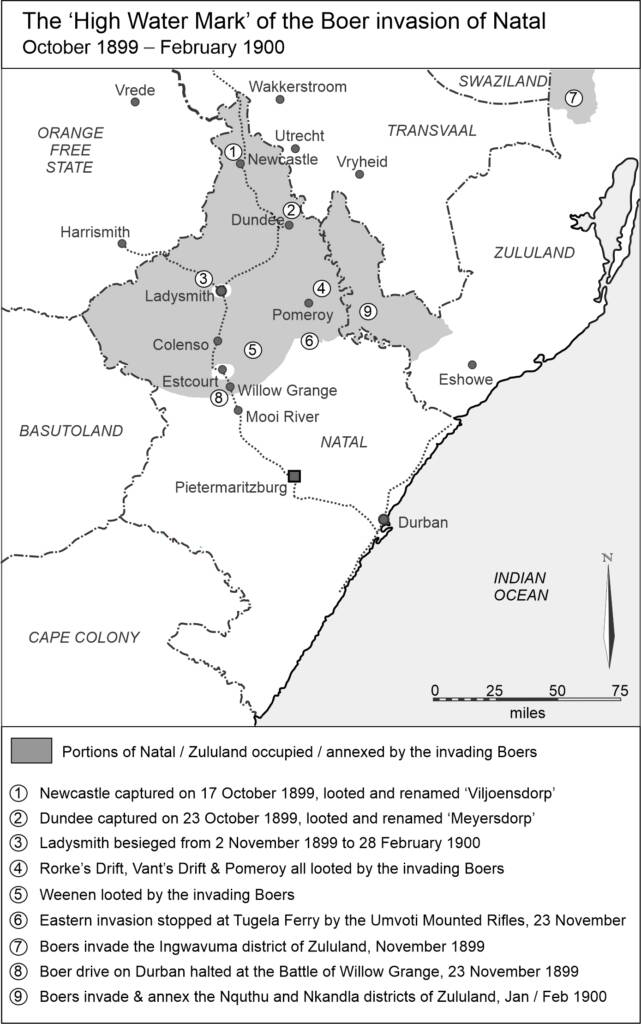
If the Boers ‘only’ wanted to dig in along the Tugela – rather than the border, which was much more defensible[7] – why, one wonders, did they invade and grab parts of Zululand?
In reality, and despite Seymour’s self-serving squeals, the invading Boers desperately wanted to take Durban – that, indeed, was the whole point of the invasion of Natal. Jan Smuts – who finalised the invasion plans – told his biographer (and son) that the aim of invasion of Natal was ‘to strike down swiftly at Durban and the other ports upon the outbreak of hostilities, in order to prevent the British landing reinforcements. That phase completed, the mopping up of troops in the country would begin’.[8]
And if, for some reason, the words of the man who actually drew up the Boer invasion plans aren’t enough to convince you, let me quote from General Maurice’s official history:
‘A Krygsraad, at which all the Boer generals and commandants attended, had assembled in front of Ladysmith on 1st November to decide whether the main effort of the Boer army should be concentrated on the attack of that town, or whether, leaving a detachment to hold Sir G. White’s troops, they should at once advance on Maritzburg and Durban. Some of the younger leaders, including Louis Botha, as yet only plain commandant, were in favour of the latter course. The majority of the council decided that, so long as 12,000 effective British troops remained at Ladysmith, the commandos were not numerous enough to allow them to win the much-coveted prizes of the capital and seaport of Natal.’[9]
As General Maurice makes clear, it was only the bloodied, but unbowed, Imperial garrison still valiantly holding on in Ladysmith that gave the invaders cause to hesitate; there was no way that the entire Boer invasion force could push on towards the coast with 12,000 undefeated Tommies sitting astride the railway which was their would-be supply line. Nevertheless – after the Boer attempt to storm Ladysmith on the 9th of November failed miserably,[10] and completely ignored by Seymour – Joubert and Botha did indeed make a dash for Durban. Leading a 4,200 strong[11] strike force[12] they set off from Colenso on 13 November, and pressed on for the coast, rampaging and looting their way south as far as Mooi River.
Lacking the strength to take on the British garrisons which had been hurried up the line to hold Estcourt[13] and Mooi River[14], however, Joubert had little choice but to retreat (laden down with loot) after the Battle of Willow Grange.[15] This was much against the wishes of Botha, who – demonstrating an incredible inability to see the bigger picture and understand the strategic situation – wanted to push on.[16] Joubert piously (if ludicrously) claimed lightning strikes during the battle to be ‘an infallible sign from the Almighty that the commandos were to proceed no further’.[17] Always against Kruger’s insane invasion, the old General was also suffering after a heavy fall from his horse,[18] and was probably rather more worried that heavy rains meant the Tugela was rising, thus cutting off any chance of retreat.
Completely contrary to the wild claims of Mr Seymour, it was only then – with their drive towards Durban thwarted by British reinforcements and their dreams of snatching a sea port dashed – that the retreating Boers pulled back to the Tugela, and dug-in to try and hold at least some of their ill-gotten gains.

So why would Mr Seymour endeavour to claim something which is so easily – nay, effortlessly – disproved? Was it just a case of complete ignorance of the war – had he really never heard of the Battle of Willow Grange? Presumably the world-famous capture of Winston Churchill at the Armoured Train Incident[19] is also completely unknown to Seymour? Perhaps he thinks that Frere is north of the Tugela – a startling revelation which would completely change our understanding of South Africa’s Geography, not just its History.
Or – much more likely – is that Seymour was rather sneakily hoping to get away with just making something up, and hoping that someone who has written several books on the subject would not spot, and call him out on, his bizarre version.
Either way, and with that aspect of his nonsense disproven, let’s look at the funniest bit of his rant.
Given that – as just mentioned – the invading Boers proved completely incapable of capturing Ladysmith (and, indeed, Mafeking, Kimberley, and, later, even little Wepener), it is remarkable that Seymour airily declares that the Boers could have strolled into Durban had they wanted to. As pleasing as this claim obviously is to some, it is simply rubbish, as I explored in these more recent articles:
https://www.chrisash.co.za/2022/04/13/durban-or-bust/
https://www.chrisash.co.za/2026/06/01/could-botha-ever-really-have-eaten-those-bananas/
Of course, whenever the Boers proved incapable of doing something, the MO of the True Believers is to simply declare that they didn’t really want to do it anyway – perish the thought! Thus, the Boer defeats at Belmont, Graspan and Modder River (for example) are all waved away, with the faintly ludicrous excuse that the Boers didn’t really want to defend those positions in the first place. Similarly, the complete failure of the Boers to capture Ladysmith, Mafeking, and Kimberley is excused by screaming the pie-in-the-sky claim that they didn’t really want to take those towns at all.
Perhaps Seymour was simply – and unthinkingly – following this trend when he assured us, in the face of all the evidence, that the Boers could have waltzed into Durban, but, inexplicably and magnanimously, chose not to.
Unfortunately for Seymour, and the other Defenders of the Myth, this claim is also very easily refuted, as I showed in the articles above. In these, I confirmed just how much the British garrison of Natal had been increased in the weeks after the Boer invasion, and thus how utterly far-fetched it is to claim that Joubert and Botha could have merrily skipped down to Durban ‘if they had wanted to’. What I did not cover in terribly much depth in those articles, however, was just how well-defended Durban itself was by that point, so I thought it was worth revisiting that aspect here.
As touched upon in the articles linked to above, the Royal Navy put a strong landing party into Durban on 8 November 1899, and extensive defences were dug and prepared. The reader will note that this was five days before Joubert and Botha set off from Colenso on their march to the coast. Commanded by the indefatigable Captain Percy Scott RN,[20] the Blue Jackets manned no less than twenty 12-pdrs, one 4.7-inch gun, and the pair of 6-inch guns at Bluff Fort, plus smaller guns and Maxims. A 300-strong force of Royal Marines (with more Maxims) was held as reserve, and RN personnel manned a pair of armoured trains armed with 3-pdr QF guns. It is worth taking a moment to let those numbers sink in: in terms of long-range naval guns, that was far more than were at Ladysmith[21] and about five times the number of guns Joubert and Botha were dragging south. Furthermore, the RN guns at Durban were all well dug-in and emplaced, and had copious stocks of ammo at hand.
A new regiment, the Imperial Light Infantry,[22] was forming in Durban at the time,[23] though largely comprised Johannesburgers who had who had lost their jobs and businesses due to the war.[24] Commanded by Lt. Colonel Nash of the Border Regiment, it was certainly not the like-for-like of a regular British battalion – and never gained the kudos of the Imperial Light Horse – but was fully-equipped, some 1,000 strong,[25] and would have been deployed to defend the town as needed.
Additionally, Durban, being a much larger town than Ladysmith[26], could also field a substantial Town Guard in extremis, and many hundreds (thousands?) of these men would have backed-up the Blue Jackets, Marines, and Imperial Light Infantry. The Governor had called out the volunteers of the Rifle Associations on 3 November[27] for this very purpose, and they began practicing drilling and musketry[28] ready to defend their homes.[29] Had they been called upon, their contribution should not be taken lightly: the farmers of Nottingham Road had mustered to drive off a Boer probe,[30] while – over in the dusty expanse of the Karoo – the Loyalist menfolk of tiny Kuruman held off the Boer invaders for six weeks.[31] When it came to Durban, one witness recalled, ‘A corps of mounted local gentlemen undertook all the scouting beyond the town, and the district rifle associations were ready to co-operate with the defence force if required. This colony well deserves the title of ‘Loyal Natal’.’[32]
As well as these well-prepared and well-dug-in forces, had Joubert’s strike force simply bypassed the British garrisons at Estcourt and Moor River (and the fortifications which had by then been prepared at Pietermaritzburg[33]) and pushed on to the coast, those troops could obviously have moved south to engage and cut off the Boers as they approached Durban.
Furthermore, the very fact that Durban was a port would have made it far easier for the British to defend than was the case of the inland towns which were besieged in reality.
Firstly, with the few, relatively light guns that Joubert and Botha had, and with Royal Navy having complete control of the sea, it would have been virtually impossible for the Boers to prevent British shipping from keeping the town supplied, landing reinforcements, or removing wounded troops / civilians. Logistically, therefore, any hypothetical attack on / siege of Durban would have been a completely different situation to the three famous sieges which happened during the war – all of which, let us remember, were abject failures for the invading Boers in any case.
Even more importantly, in an hypothetical attack on / siege of Durban, the British defences would have been covered by the massive firepower of Royal Navy cruisers and gun boats lying offshore – a flotilla which would have been reinforced with even larger vessels as required. It is difficult to wrap one’s head around the sheer firepower of battleships of the age, when compared to field artillery. The firepower of a single Majestic-class battleship, for example, was equivalent to the artillery of about three British army divisions of the period; the battleship (using its broadside of four main 12-inch guns, and half of its secondary armament of 6-inch guns) could maintain a bombardment of about 6400lb per minute, compared to about 2160lb per minute for the eighteen 15-pdr guns of an army division – and the ship’s guns had much greater range as well.
Joubert and Botha had pushed south towards the coast with just four or five relatively light field pieces, meaning the mismatch in firepower would have been absolutely off the chart. Had they decided to go toe-to-toe with a Royal Navy cruiser or battleship, the Boer gunners would have been blown into the middle of next week.
They say a picture is worth a thousand words, so hopefully this map should give an idea of just what a tough nut Durban would have been to crack:
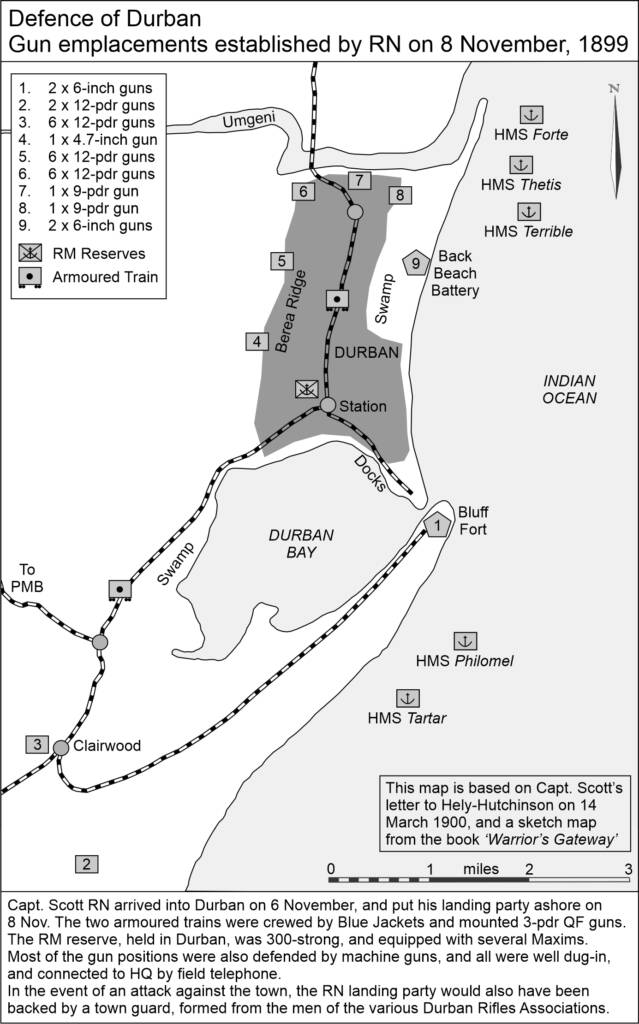
If some 20,000 Boers, with heavy guns, completely failed to take Ladysmith, it is beyond laughable to pretend that, ‘had they wanted to’, Joubert and Botha could have swept into Durban with under 5,000 men and a few field guns – and at the end of an extremely long and tenuous supply line.
It really is a simple as that – no matter how one prefers to spell ‘Tugela’.
NOTES:
[1] ‘The explanation of the war as a capitalists’ conspiracy must be discarded; it is too smooth and rounded to fit easily into the jagged background of events and personalities, although it appealed at the time to some who were sophisticated and some who were simple minded’
– Le May, British Supremacy In South Africa, 1899-1902, p.29
and:
‘[Britain’s critics are] perfectly well aware that England will derive no benefit from the gold mines, nor will she take possession of them any more than she has done of the gold mines of Australia. They are private property.’
– Guyot, Boer Politics, p.33
and:
‘The evidence so far produced does not support the view that the British Government went to war in 1899 to bring the gold supply or the gold fields under British control or to protect British trade or the profits of cosmopolitan capitalists in the Transvaal. None of these was under serious threat, even if it was acknowledged that the capitalists did suffer from unnecessary impositions at the hands of a corrupt and inefficient government. The Transvaal was not the only part of the world where this occurred; despite their justifiable complaints, the capitalists on the Rand not only made sizable profits, under Kruger’s government, but were also successful in attracting the large-scale private investment which was so essential to their operations. While some of their leading members, by 1899, certainly looked to a British takeover in the Transvaal as likely to benefit their interests, there is as yet no evidence that their views formed a significant part of the British Government’s considerations in its mounting conflict with the Transvaal government of President Kruger. Transvaal gold formed only a small proportion of the low level of British gold reserves, which was a deliberate feature of Bank of England policy before, during and after the South African War.’
– Iain Smith, quoted in Lowry, The South African War Reappraised, p.44
and:
Indeed, Smith even concedes that, ‘only after the war had begun did the British Government decide to annex the Transvaal, and her ally and sister republic, the Orange Free State. This had not been the original objective’.
– Iain Smith, quoted in Lowry, The South African War Reappraised, p.45
and:
‘Britain based the defence of her monetary stability, in the event of international gold rushes, on her position as a creditor nation, but did not build up a massive gold reserve beyond what was required for the issue of currency … France, too, defended the stability of her currency based on a status as a creditor nation, but in addition, she built up a massive gold reserve as a second line of defence. France, not Britain, was the greatest European purchaser of new gold for strategic purposes … there were no compelling reasons at that particular moment for Britain to wish to control the government of the Transvaal in order to have control over its gold mines. Whatever gold was mined in the Transvaal would in any event find its way to the international gold market and the European Monetary System, to which Britain had as much access as anybody else. Moreover, whoever bought the gold had to pay the companies that mined it. The mining companies made profits from selling gold, not those who controlled the governments of the producing countries. For Britain, there would thus be enormous disadvantages in taking over the Transvaal, but no conceivable economic advantage to governing a gold-producing colony—it was a much better proposition to hold prime trading rights with a gold-producing colony. There was thus no economic imperative driving Britain to covet the Transvaal for its gold.’
– John Stephen, Fuelling the Empire, p.262
and many others
[2] https://www.chrisash.co.za/2020/09/22/secret-conferences-pretoria-june-1887/
[3] Though still longer, indeed, than the British retained direct control of the conquered republics; West Germany became, for all intents-and-purposes, an independent, sovereign nation in 1955, some 10 years after the war ended. The Transvaal and the OFS had both been granted self-rule five years after the Boer War ended, and both elected Boer-dominated governments. The Union of South Africa – which established the country as, for all intents-and-purposes, an independent, sovereign nation – happened just 8 years after the end of the Boer War. This would have been a very strange course of action, had there been a dastardly British desperation to grab control of the place
[4] The ‘A-A’ line (Arkhangelsk–Astrakhan line) was the military goal of Operation Barbarossa. In the fevered minds of the True Believers, that must mean that the German invasion of the USSR was ‘defensive’
[5] The Reverend Bailey, who remained with his flock in Dundee during the occupation, recorded the way that Natalian civilians were rounded up and sent away: ‘those residents who had remained quietly in their houses were sent off to Pretoria, with the exception of half a dozen householders and about a score of women and children.’
– Bailey, Seven Months Under Boer Rule, p.69
Today, this would be seen as clear breach of Article 49 of the 1949 Geneva Convention: ‘The Occupying Power shall not deport or transfer parts of its own civilian population into the territory it occupies.’
[6] ‘The Boer population in Dundee is being added to daily. Many fresh families have arrived. They are making themselves comfortable in the houses and appear to have made up their minds that this is to be a Boer dorp now and always. Henceforth, it is to be Meyersdorp.’
– Bailey, Seven Months Under Boer Rule, p.87-88
[7] The only railway line up into the Transvaal from Durban snaked its way up the pass at Laing’s Nek – which is about the most perfect defensive terrain imaginable. Another railway from Natal entered the OFS, but only went as far as Harrismith – this went up through Van Reenen’s Pass which is, if anything, even more formidable terrain than Laing’s Nek
[8] Jan Christian Smuts by his son, p.90, quoted in O’Connor, A Short Guide to the History of South Africa, 1652–1902
[9] Maurice, History of the War in South Africa 1899‒1902, Vol.1, p.264
[10] For details of this studiously overlooked Boer defeat, see Conan Doyle, The Great Boer War, p.213; Wylly, History of the Manchester Regiment, Vol.2, p.12; Danes, Cassell’s History of the Boer War, Vol.1, p.214; Jacson, The Record of a Regiment of the Line, p.34; and many others
[11] Amery puts this number at 6,000
[12] Maurice, History of the War in South Africa 1899‒1902, Vol.1, p.265
[13] By 23 November, Estcourt was held by the 1st Border Regiment, 2nd Dublin Fusiliers, 2nd West Yorks, 2nd East Surreys, 5 coys of the 2nd Royal West Surreys (known as ‘the Queen’s’, the balance of the battalion was down in Mooi River), the MI coy of the 2nd KRRC, 7th Battery RFA and a pair of RN guns. These regular forces were reinforced by the Durban Light Infantry, Natal Royal Rifles, a squadron each of the ILH and Natal Carbineers, Bethune’s MI, a contingent of Natal Police, and the Natal Field Artillery battery
[14] Mooi River was held by the 2nd Devons, 1st Royal Welsh Fusiliers, 2nd Royal Irish Fusiliers, 3 coys of the 2nd Royal West Surreys (the balance of the battalion being in Estcourt), 14th Battery RFA, and the newly-raised Thorneycroft’s MI. On 22 November, Mooi River was briefly bombarded by two Boer guns, but the invaders withdrew once the British infantry deployed
[15] Also known as ‘Brynbella’, this was an inconclusive engagement fought on the night of 22/23 November 1899. Moving south from Estcourt, Colonel Walter Kitchener commanded a force which comprised a RN 12-pdr, the 7th Battery RFA, a half-battalion of the 2nd West Surrey (Queen’s), the 2nd battalion West Yorkshire, four companies of the Durban Light Infantry, and seven companies of the 2nd East Surrey regiment. They were later reinforced by the 1st Border Regiment. Kitchener’s troops executed a night assault against the Boer-held hill, only to find the invaders had already withdrawn to another one. The following morning, Kitchener’s men came under artillery fire which they could not return, and he withdrew his force back to Estcourt
[16] Amery, The Times History of the War in South Africa, 1899–1902, Vol.2, p.317
[17] Viljoen, My Reminiscences of the Anglo-Boer War, p.30
[18] Conan Doyle, The Great Boer War, p.220
[19] On 15 November 1899, young Winston Churchill (then working as a war correspondent for the Morning Post) was famously captured when the armoured train he was riding in was ambushed between Frere and Chieveley. It is remarkable that Mr Seymour can be blissfully unaware of this event
[20] Scott, Fifty Years in the Royal Navy, p.341
[21] In addition to six RFA 15-pounder batteries – which proved to be hopelessly out-ranged by the more modern republican pieces – the garrison at Ladysmith could call upon just six long-range RN guns: four 12-pdrs, and two 4.7-inch guns
[22] The men of the Imperial Light Infantry took their boozing seriously: ‘When at full strength the regiment got through more than one hundred fifty-four gallon casks [of beer] in a week; in fact, throughout, the war the various Natal brewery companies did remarkably well.’
– Boscawen-Wright, With the Imperial Light Infantry Through Natal, p.14-15
[23] Maurice, History of the War in South Africa 1899‒1902, Vol.1, p.265
[24] Minutes of Evidence taken before the Royal Commission on the War in South Africa, Vol.2, p.443
[25] Stirling, The Colonials in South Africa 1899–1902, p.83
[26] Durban had a population of some 35,000 in 1899, of whom about 12,000 were of British extraction, with the rest mainly Africans and Indians
[27] Wasserman & Kearney, A Warrior’s Gateway, Durban in the Anglo-Boer War 1899-1902, p.90
[28] Woodville Examiner, 3 January 1900 – quoting a letter dated 20 November 1899
[29] Though the volunteers were called-out, mustered and exercised, in the event the men of the Durban Rifle Association were not issued uniforms, and nor, does it seem, were they entitled to a Queen’s South Africa Medal.
[30] Martin, The Durban Light Infantry, Vol.1, p.75
[31] Outnumbered over 10:1, a handful of Cape Police backed a few dozen loyalist volunteers defied the invading Boers for six weeks, only surrendering when republican artillery was brought up to pound Kuruman into submission. There is no reason to think that the townsfolk of Durban would have shown less fighting spirit
[32] Crowe, The Commission of HMS Terrible, Ch.5
[33] Under the supervision of Colonel Rawson RE, the barrack complex at Pietermaritzburg’s Fort Napier had been readied as a defensive position with earthworks dug and barbed-wire entanglements strung out. A RN landing party from HMS Tartar manned a pair of 12-pdrs and a 7-pdr, a town guard had been formed from any and all able-bodied volunteers, and a mounted volunteer unit of Natal loyalists called ‘Murray’s Horse and Scouts’ patrolled the area

3 Comments
A well written and researched commentary, as usual, from Bulldog. Gives a great summary and suitable response to a ludicrous statement from Meneer Seymour.
Very difficult to argue against well reasoned and thoroughly researched information. As a recipient of the apartheid era school system history this was never even brought up. Arguably because it did not fit the agenda. It was simply that the ever bad English wanted the gold and the invasion of Natal was a “defensive” pre emptive strike as opposed to what it really was, a Offensive strike. Not Pre emptive at all as war was already declared ie cause before effect.
Thanks for the comment.
The whole ‘pre-emptive’ strike excuse really is a joke… no one ever bothers to explain what, exactly, it was ‘pre-empting’. As I have shown in previous articles, it did not even come close to meeting the Caroline test: there were no British troops ‘massing on the border’, no invasion plans were in place, no threats had been made. Sure, at some point in the next 20 years, Britain ‘could’ have invaded the republics… but that is a truly pathetic excuse. Sweden can’t just invade Norway today, claiming that it’s pre-emptive as Norway might, at some random and unspecified point in the future, attack them.
Add Comment