

While we all know that nothing but myth-laden nonsense will endlessly spew out of certain South African universities, one really hopes for a little more from an august institution such as London’s National Army Museum. It was rather a shame, therefore, to see that whichever work experience trainee they got to write the page on the Boer War, seems to have spent about 5 minutes on Wiki before embarking on the task:
https://www.nam.ac.uk/explore/boer-war
First up, we are treated to this throw-away nonsense:

No mention that Kruger desired to build an Afrikaans Empire ‘from the Zambesi to the Cape’,[1] no mention that the Transvaal had expanded in every direction for years, no mention of the ongoing ‘cold war’ between the Transvaal and the British Empire. And certainly no mention of the very crux of what really caused the war, which was, as Andrew Roberts asserts, ‘the two obstinate bearded old patriarchs, Salisbury and Kruger, both knew that this struggle was actually about ultimate regional paramountcy, about showing who was ‘Boss’ in South Africa’.[2] In a nutshell, the British were the paramount power in the region in 1899, and Kruger wanted to replace them.
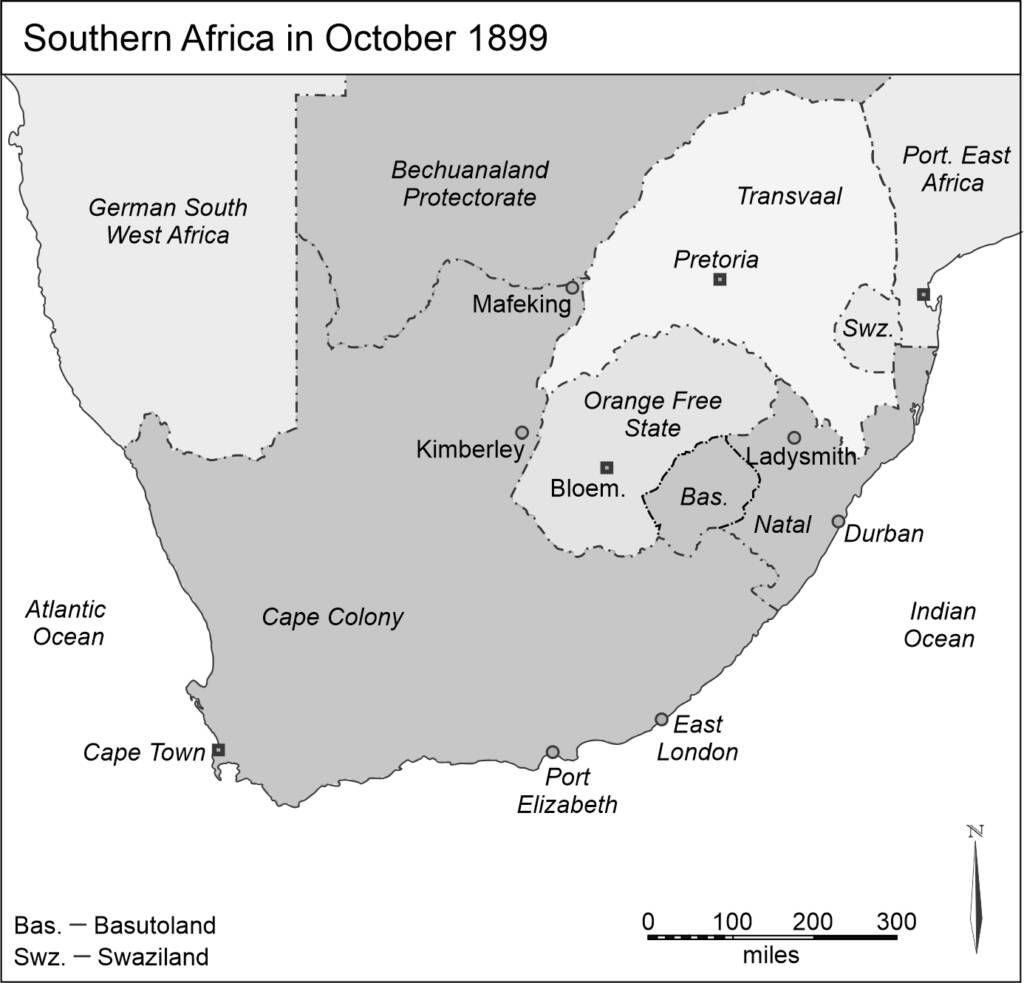
And so, with the side that declared war and invaded cleared of all culpability whatsoever, next up we are presented this map, which claims to represent South Africa c.1899:

Needless to say, this map is somewhat flawed. Not only is Mafeking bizarrely shown to be inside the borders of the Transvaal, but the frontier between that republic and Natal is hopelessly incorrect, showing, instead, what the border looked like when it was re-drawn several years after the Boer War.[3] Swaziland and Basutoland appear as giant, un-named, inland seas, and I was fascinated to learn that the Modder River flows through Bloemfontein, while the Vaal flows through Kimberley. Ladysmith and Colenso are depicted too far north, and Durban seems to have moved down the coast about 100 miles.
Spot the differences:
And if that was not bad enough, things quickly got worse:
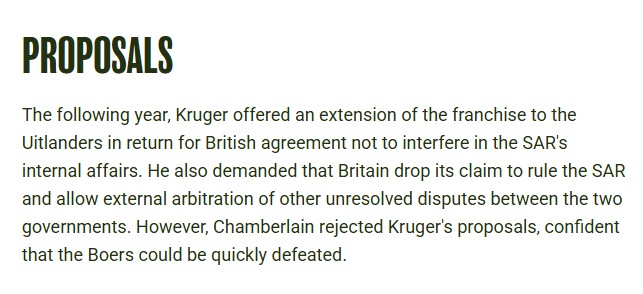
This is, quite simply, nonsense. At no point did Kruger offer a fair and transparent extension of the franchise to the Uitlanders. He did, however, come up with all manner of condition-laden, opaque and ever-changing nonsense, which was designed both to waste time, and to keep his Chosen People in power, lording it over everyone else… now, when else have we heard that in South African History?
In fact, when he arrived at a conference to discuss the issue, Kruger showed that reaching a reasonable compromise on the franchise was the furthest thing from his mind, unveiling a long list of things he wanted to talk about first:
‘President Kruger, in accordance with his custom, began on a number of side issues, instead of going straight to the point, thus employing the method, known to most of us who have had dealings with mistrustful and ignorant peasants. He raised among others the following questions: (1) Swaziland, which he wanted to annex; (2) The mobilization of the army; (3) The payment of the Jameson Raid indemnity; (4) The uitlanders’ petition; (5) The gold law; (6) The mining law; (7) The liquor law; (8) The tariff law; (9) The independence of the Republic; (10) The dynamite monopoly; (11) Arbitration on all disputed points; (12) British intervention in the internal policy of the South African Republic. And then, added Kruger, ingeniously, when all these matters have been disposed of, we can take up the question of franchise.’[4]
Unsurprisingly, Milner[5] – heading-up the British delegation – was having none of this. Refusing to be side-tracked he insisted on discussing the matter at hand. Faced with a determined British representative for the first time, some of the Boer leaders realized that the rules had changed. Steyn and Smuts both pleaded with Kruger to agree to Milner’s straightforward demands: a retrospective five-year franchise (which, far from being onerous, would only have brought the Transvaal into line with the rest of southern Africa) and reasonable representation for the mining areas.[6] Essentially, this would have meant that any white man who had settled in the Transvaal before 1894, and who had enough property to qualify, would have a vote.
A distraught Kruger reckoned these numbers at over 60,000,[7] inadvertently admitting just how many uitlanders his ghastly, corrupt and deeply racist regime discriminated against. Milner even proposed that any uitlanders desirous of the vote should take ‘an oath to obey the laws, undertake all obligations of citizenship, and defend the independence of the country’.[8] Hardly the words of a man determined to annex the place. Despite enjoying the support of Steyn and Smuts, it is this eminently reasonable demand which has caused latter-day pro-Boer writers to present Milner as a warmongering psychopath.
The aspirations of the Uitlanders – and the line taken by Milner – was not in any way unreasonable: no less reasonable, indeed, than the determination of non-white South Africans to gain the vote from the later Apartheid regime. Instead, it was entirely thanks to Kruger’s pig-headed refusal to bring the Transvaal’s franchise system in line with the rest of the territories of South Africa that the talks broke down. But even then, diplomacy continued for the following few months, and Britain showed no inclination to turn to military means so as to force greater democracy on the republic. These diplomatic efforts only ended when Kruger – like the utter lunatic he was – declared war on Great Britain.
And as for the unreferenced, throw-away remark that Chamberlain[9] – the Colonial Secretary – was ‘confident that the Boers could be quickly defeated’, what he actually said was:
‘A war in South Africa would be one of the most serious wars that could possibly be waged. It would be in the nature of a civil war. It would be a long war, a bitter war, and a costly war, and it would leave behind it the embers of a strife which, I believe, generations would hardly be long enough to extinguish’.[10]
I wonder why that was left out?
Then we get yet more hogwash:
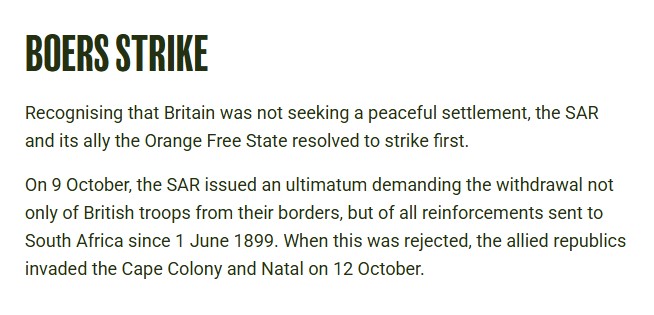 No mention of the fact that Kruger had been planning on attacking the British since at least the Secret Conferences of 1887.[11] No mention of the Bogus Conspiracy.[12] No mention of the endless rabble-rousing and gun-running antics of the Transvaal Secret Service in British territory.[13] No mention of the mass splurge on weaponry by the Transvaal (which pre-dated the Jameson Raid). And no mention that – aside from a few scattered garrisons – there were no British troops on the borders,[14] as Amery explained [emphasis is mine]:
‘The British troops on or near the borders of the Transvaal at that moment were a small force of 600-700 men under Colonel Baden-Powell at Ramathlabama, near Mafeking, and the force of about 4000 men under Sir W. Penn Symons at Dundee, some fifty miles from Laing’s Nek’.[15]
In reality, there was only one side who had long-since[16] determined there would be no ‘peaceful settlement’ (to the problem that was entirely of Kruger’s making) and that was – surprise, surprise – the side that mobilised first, declared war, and invaded their neighbours. And as for the attempts to explain away this blatant aggression by claiming that the Boers ‘resolved to strike first’, one should note that Britain had no plans to ‘strike’,[17] and precious few troops in theatre to do so. Attempting to excuse Kruger’s invasions in this way is like frantically justifying Germany’s 1939 invasion of Poland as them simply ‘resolving to strike first’.
Then we get a rather laughable attempt at a time-line:

No mention that the British army mobilised after both Boer republics mobilised:[18] the Transvaal mobilised on 27 September 1899,[19] and – after much bullying and lubrication from Kruger – the Orange Free State followed suit on 2 October 1899.[20] Both had mobilised hundreds of artillery reservists several months prior to this[21] and Kruger had started sending his men to the border of Natal on about 10 September.[22] One is left to wonder why none of these inconvenient facts were considered worthy of including in the time-line?
And – incredibly – the sheer nonsense continues:

This is perhaps my favourite bit: the claim that the Battle of Laing’s Nek was fought on 12 October 1899… instead of way back in 28 January 1881, in a completely different war. There could not possibly have been a ‘Battle of Laing’s Nek’ on 12 October 1899, as the invading Boers only finally bumped into a significant force of British troops when they got to Dundee – nine days after they invaded Natal.
On and on then nonsense goes, with the normal myths about the British only being used to fighting ‘poorly armed opponents’ and how ‘The British launched frontal attacks on concealed Boer positions. These were ineffective and led to several defeats in December 1899’ – which studiously ignores the string of British victories before this at Talana Hill, Elandslaagte, Belmont, Graspan and Modder River.
Before we get to this humdinger:

Yup, really: we are now assured that the ‘Battles of Glencoe and Dundee’ (better known as the Battle of Talana Hill) were fought on 15 May 1900 – rather than, in reality, on 20 October 1899.[23] Who knew: apparently the first pitched battle of the war actually only happened 7 months after the Boers invaded!?
This really is an incredibly embarrassing offering by such a well-respected Museum – and shows just how deeply the myths have infected the common understanding of the war. Of course, some will scoff, and scream: “So not only the University of Pretoria, but now the National Army Museum!? Just who does he think he is! How dare this ‘enfant terrible’ claim he knows more about the Boer War than these experts!?”.
Well, if you genuinely believe that, please come back to me and prove me wrong in the points I made above. Just like I have asked a thousand times for people to point out the mistakes in my books, and to answer the challenges I set in previous blog articles.[24]
I won’t hold my breath.
NOTES:
[1] Farrelly, The Settlement after the War, p.173
[2] Roberts, Salisbury, Victorian Titan, p.732
[3] Understanding the vulnerability of the ‘triangle’ of Klip River County – that portion of Natal which jutted up between the Orange Free State, to the west, and the Transvaal, to the east – is crucial to grasp how the war was fought, and why no attempt was made by the British to defend either Laing’s Nek or Newcastle
[4] Guyot, Boer Politics, p.91
[5] Later, Alfred Milner, 1st Viscount Milner, KG, GCB, GCMG, PC (1854 – 1925). A brilliant statesman and administrator, Milner was (much later) reinvented as the architect of the Boer War by Pakenham, and has served as the Pantomime villain of the piece ever since
[6] Walker, A History of Southern Africa, p.480
[7] Pakenham, The Boer War, p.66
[8] Cook, The Rights and Wrongs of the Transvaal War, p.138
[9] Joseph Chamberlain (1836 – 1914) was the Secretary of State for the Colonies from 1895 and 1903. He was the father of the Prime Minister at the start of the Second World War, Neville Chamberlain
[10] African Affairs (2000), 99, 633-648, Professor Andrew Porter, The South African War and the Historians
[11] https://www.chrisash.co.za/2020/09/22/secret-conferences-pretoria-june-1887/
[12] Amery, The Times History of the War in South Africa, Vol.1, p.301
[13] https://www.chrisash.co.za/2026/07/18/the-indian-reinforcements-and-understanding-the-timeline/
[14] https://www.chrisash.co.za/2024/09/11/massing-on-the-border-more-maps/
[15] Amery, The Times History of the War in South Africa, Vol.1, p.354
[16] Kruger’s determination to start a war with the British Empire can be traced at least as far back as the Secret Conferences of 1887 – for more, see Fraser, Episodes of my Life, p.145-147
[17] Royal Commission on the War in South Africa, Vol.1, p.429
[18] The inconvenient reality (for those desperate to paint Britain as the nasty bully of the piece) is that the Transvaal mobilised on 27 September 1899, and the Orange Free State followed suit on 2 October 1899. Both republics had mobilised hundreds of artillery reservists several months prior to this
[19] Amery, The Times History of the War in South Africa, Vol.1, p.358-359
[20] Amery, The Times History of the War in South Africa, Vol.1, p.368
[21] War Office, Military Notes on the Dutch Republics of South Africa, p.27, and Jersey Evening Post, 14 August 1899
[22] Farrelly, The Settlement after the War, p.213
[23] Maurice, History of the War in South Africa, Vol.1, p.129
[24] https://www.chrisash.co.za/2026/07/01/20-questions-for-the-true-believers/
https://www.chrisash.co.za/2025/10/02/c-s-lewis-and-the-cowardice-of-the-true-believers/
https://www.chrisash.co.za/2025/10/14/another-challenge-for-the-true-believers/

Add Comment