

It always amazes me just how little many of those who write about the Boer War know about military history in general, and the British army in particular. Pakenham, for example, had clearly never heard of the old ‘3 to 1’ rule-of-thumb needed for a successful infantry attack. Displaying similar ignorance, Prof Pretorius gleefully / mindlessly gave a rave review of a book which perversely claimed a British infantry brigade of the period was made-up of two regiments, each of two battalions… and which also stated there was a regiment in the war called the ‘Royal North Lancashire Regiment’.[1]
It was thus not terribly surprising to see another example of this lack of knowledge in a book I recently acquired, with my eye quickly drawn to this remarkable claim:

Stating that the ‘10th Lancers’ were part of the British army garrison of Ladysmith at the start of the war is an astonishing assertion, as no such regiment served in Natal at any point of the campaign. And this is not an esoteric point of confusing the arrival date of a certain unit, muddling up which squadron was held in reserve in a certain action, or getting the 1st and 2nd battalion of regiment mixed up.
There was, quite simply, no such regiment in the British army as the 10th Lancers.[2]
This is a proper schoolboy howler, as anyone with even the most basic knowledge of the British army of 1899 knows that there were only six Lancer regiments at that time: the 5th, 9th, 12th, 16th, 17th, and 21st.[3] Furthermore, only one of these – the 5th (Royal Irish) Lancers – served in the Natal Campaign. Four of the other lancer regiments served in the Boer War, but the 21st[4] did not deploy to South Africa.[5]
Here is the actual distribution of troops in Natal, on the day the Boers invaded:[6]
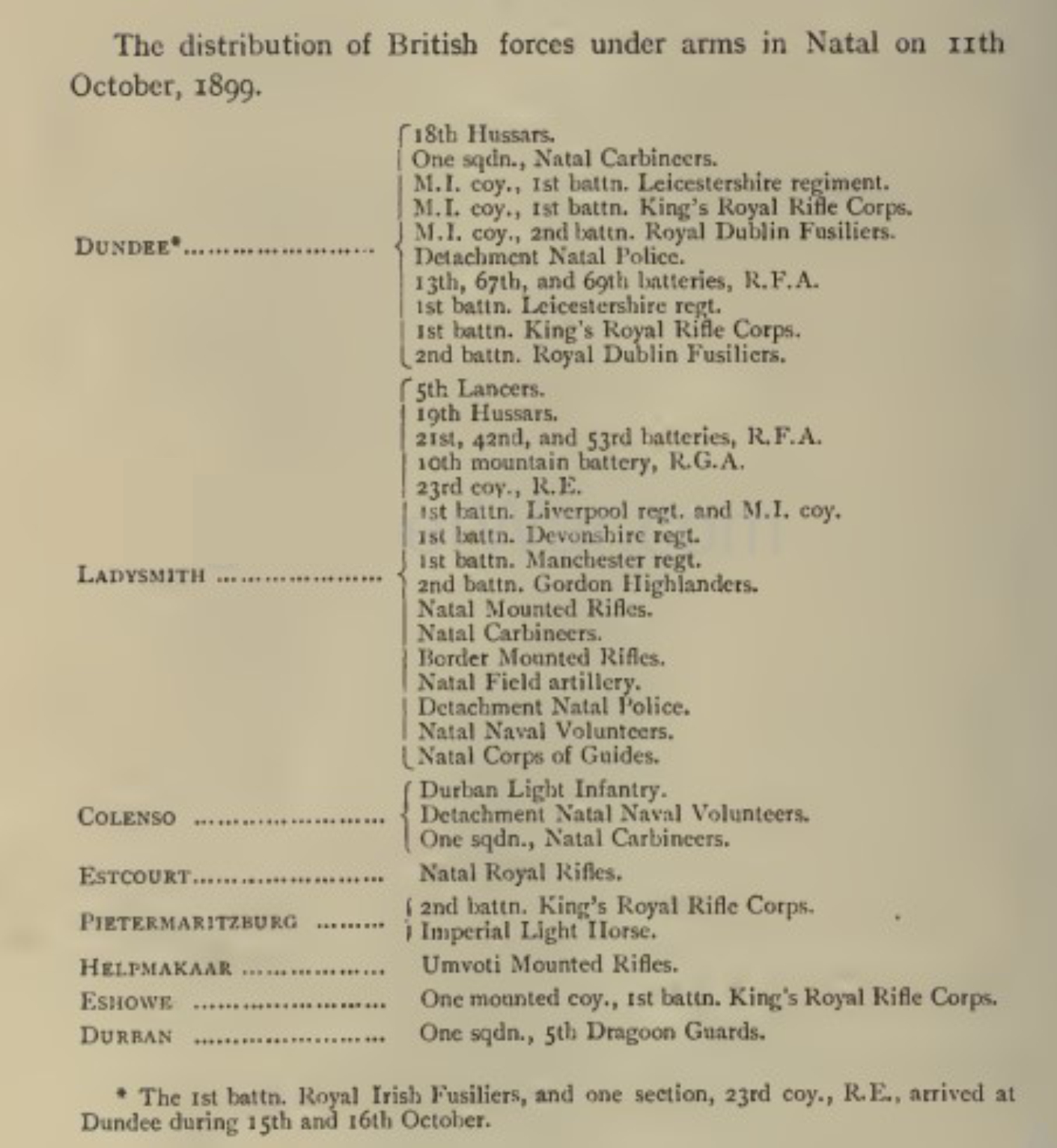
You will see that the other version ignores the 19th Hussars, and invents a mythical regiment called the 10th Lancers. Now that’s quite a typo. A British cavalry regiment called the 10th (Prince of Wales’s Own Royal) Hussars did serve in the Boer War, but not in the Natal Campaign. Furthermore, the 10th Hussars were certainly not in Ladysmith when the Boers invaded, as they only arrived into Cape Town in December 1899.[7]
Funnily enough, this mistake might be the reason why an (ahem) ‘senior member’ of a Boer War discussion site unthinkingly treated his spellbound audience to this utter nonsense:
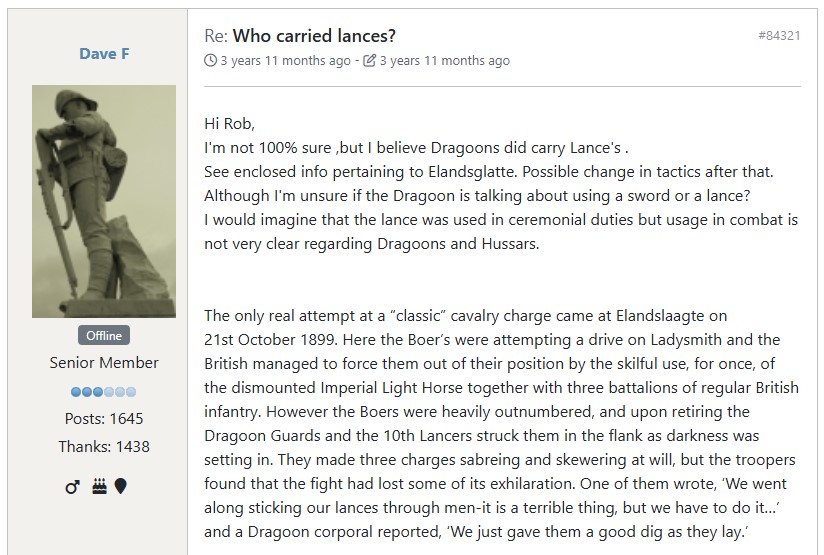
Needless to say, it was actually elements of the 5th (Royal Irish) Lancers, not the mythical 10th Lancers, who (along with elements of the 5th Dragoon Guards) charged at Elandslaagte. The inane comments about the British being ‘skilful… for once’, and explaining away the Boer thrashing by claiming they were ‘heavily outnumbered’, are simply the stock in trade of the Defenders of the Myth… and one is left wondering just how ignorant a ‘junior member’ of the site must be.
Of course, one can only expect such endless drivel in the online echo chambers, but it has always struck me as a little extraordinary that someone would set out to write a book about Boer War, despite not having even the most rudimentary understanding of the British army of the period. It would be like me knocking out a book about quantum physics, or the history of crochet in Bulgaria.
Still, I suppose cheerfully flaunting this ignorance is only following a tradition started by Pakenham, Pretorius, Boje, Griffith, Cloete, Coetzer et al.
NOTES:
[1] https://www.chrisash.co.za/2019/02/01/how-to-get-a-glowing-review/
[2] There was, however, an Indian army regiment of the period called the 10th Bengal Lancers. This was originally raised in the Indian Mutiny, as part of a much larger regiment called ‘Hodson’s Horse’. After the mutiny, this was split into two, and 2nd Hodson’s Horse would later be renamed the 10th Bengal Lancers (with 1st Hodson’s Horse renamed as the 9th Bengal Lancers at the same time). In 1921, the two regiments were amalgamated again, to form the 9th/10th Hodson’s Horse. Today, the regiment exists as an armoured unit of the Indian Army, and is known as 4 Horse (Hodson’s Horse). If the claim is that a regiment of the Bengal Lancers served in the Natal Campaign, that would be an even more extraordinary assertion and would absolutely revolutionise our understanding of the conflict.
[3] This changed in 1922, when the number of lancer regiments was reduced to four; the 5th and 16th were amalgamated, forming the 16th/5th Lancers, and the 17th and 21st were amalgamated, forming the famous 17th/21st Lancers. Interestingly, two additional ‘lancer’ regiments were (briefly) raised in the Second World War, the 24th and 27th – obviously, by then all the lancer regiments were mechanized – but these new regiments were soon disbanded. The 9th and 12th were amalgamated in 1960, forming the 9th/12th Royal Lancers (Prince of Wales’s), while the 16th/5th Queen’s Royal Lancers and the 17th/21st Lancers were amalgamated in 1993, to form The Queen’s Royal Lancers. Since 2015, all six of the Boer War era Lancer regiments have been combined as The Royal Lancers (Queen Elizabeths’ Own). There is still no sign of the mythical ‘10th Lancers’.
[4] The 21st had converted from Hussars to Lancers in 1897. At the time of the Boer War, their only Battle Honour was for Omdurman in 1898 – a paucity of active service which led to wags in other regiments claiming the motto of the 21st was ‘thou shalt not kill’.
[5] https://www.chrisash.co.za/2025/09/01/soldiers-of-the-queen/
[6] Maurice, History of the War in South Africa, 1899-1902, Vol.1, p.456
[7] Stirling, Our Regiments in South Africa, 1899-1902, p.441

7 Comments
A pretty strange view of the battle of Elandslaagte by that “Senior Member”. In the eyes of some, the British army just cannot do the right thing at any time. The German General Staff take on the Elandslaagte battle and the use of co-ordinated infantry, artillery and cavalry action was quite different.
Oh yes, there is a resolute determination to talk down even as comprehensive and clear-cut a victory as Elandslaagte.
Firstly, Elandslaagte was not a drive on Ladysmith – it was a foolish move, completely contrary to his orders, by General Kock, who had been persuaded by his loot-obsessed underlings to abandon his blocking position at the Mkupe Pass. I also love the way ‘the Senior Member’ pretends the Boers were ‘retiring’, rather than streaming away in a rabble, having been driven from their positions by the British infantry. And as for being ‘heavily outnumbered’, that’s the usual excuse that’s always spewed out to explain away any Boer defeat – in reality, the British infantry had nothing like the 3:1 advantage that professional soldiers use (but which the pen-pushing True Believers have never heard of).
And, what is more, Elandslaagte came hot on the heels of the Boer defeat at Talana Hill, and in the weeks before their string of defeats over on the Western Front, at Belmont, Graspan and Modder River. The notion that the British were skilful ‘for once’ at Elandslaagte is thus a laughable claim.
So where did the idea of the 10th Lancers come from? Or do these blokes just pull this shit out of their arse
I would assume the latter.
Sadly, all of this is true. It’s not just the True Believers who write this nonsense. I have had mainline historians write this rubbish either because they could not bother to check with an expert or because it might then not support the case that they were making. One historian chides john Monash for using American soldiers in World War 1 as if he just went out and found them and shanghaied them. The idea that junior commanders are given a bag of resources by their senior commanders just does not seem to permeate these people
Yes indeed.
I find that military history written by those without any sort of military background is usually very poor. This should be pretty obvious, but we are still treated to endless nonsense written by people who have never spent a day in uniform… and by those who are very clearly pushing an agenda.
Excellent and well researched! I can only imagine how terrifying it must have been to face a charge by lancers – whatever the number of the regiment!
Add Comment