

In a comment on a recent blog article, one person queried my analysis of the deeply flawed republican plan to attack and invade British territory, by (sarcastically?)[1] asking, ‘so, Kruger should have just done nothing?’
My response was to say:
Well, if by ‘done nothing’, you mean: “not start a war”, then – obviously – yes: he should have ‘done nothing’. In exactly the same way that Saddam Hussein should have ‘done nothing’ in 1990, Galtieri should have ‘done nothing’ in 1982, and Hitler should have ‘done nothing’ in 1939.
Despite all the NP propaganda, and all the nonsense people like to tell one another after a few Klippies, the Transvaal was under no threat of invasion. The Uitlanders were, of course, quite rightly agitating for a fair franchise, but that is very different from the ‘loss of sovereignty’. So there was simply no excuse or justification for Kruger to start a war against Great Britain.
The reason he did it was due to his long-held, and quasi-insane, desire to replace the British Empire as the pre-eminent power in Southern Africa.[2]
And that, in a nutshell, was the situation in South Africa in late 1899. Kruger’s Transvaal was in no way threatened with invasion. His attacks and annexations of vast swathes of British territory were not the last, desperate thrashing of a benign, innocent regime just before it was swamped by the evil Imperialist hordes. So, yes: the option to ‘do nothing’ was very much on the table.

Like Kruger, Saddam Hussein decided against ‘doing nothing’ – Iraqi troops taking up ‘defensive positions, just over the border’ in Kuwait, 1990
As I made clear in my response, no one mockingly asks if Saddam Hussein, General Galtieri or Adolf Hitler should have ‘just done nothing’, as though these poor, misunderstood fellows also had no option but to attack their neighbours. And no one ties themselves in knots, squealing that these invasions were (bizarrely) ‘defensive in nature’, in the way the True Believers frantically turn themselves inside out to pretend that Kruger’s invasions were not real invasions at all. I mean, sure, tens of thousands of armed men crossed the borders from the republics into British territory, looting, burning and killing… but that’s not a real invasion, right? Right? Perish the thought.
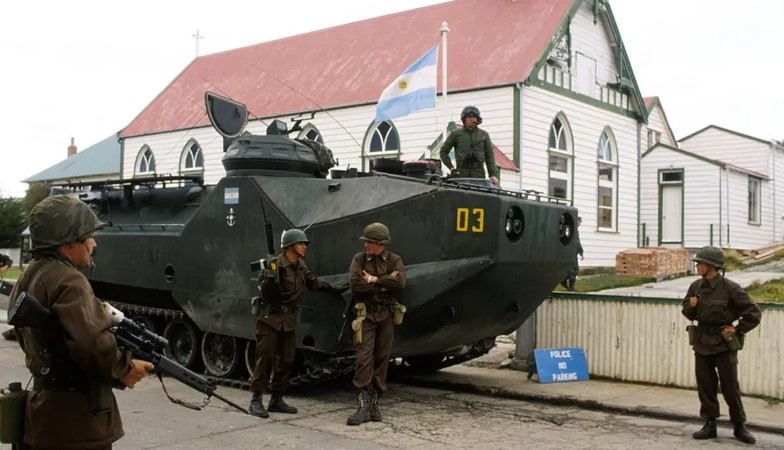
Instead of ‘doing nothing’, Argentine forces ‘take up defensive positions, just over the border’ in the Falkland Islands, 1982
Had Kruger ‘done nothing’, the persecuted Johannesburg Uitlanders would certainly (and quite rightly) have continued to push and agitate for a fair franchise – exactly as you or I would have done in their position, and exactly as the disenfranchised black population of South Africa would do so later in the 20th Century. But, rather than starting a war, Kruger could have thrown out a few bones here and there, to placate HM Government and keep everyone happy. Or, how about this: he could have just agreed to Milner’s perfectly reasonable demand, and brought the franchise rules of the Transvaal in line with the rest of the territories of the region – thus removing all the tension (tension he was entirely responsible for) at a stroke.
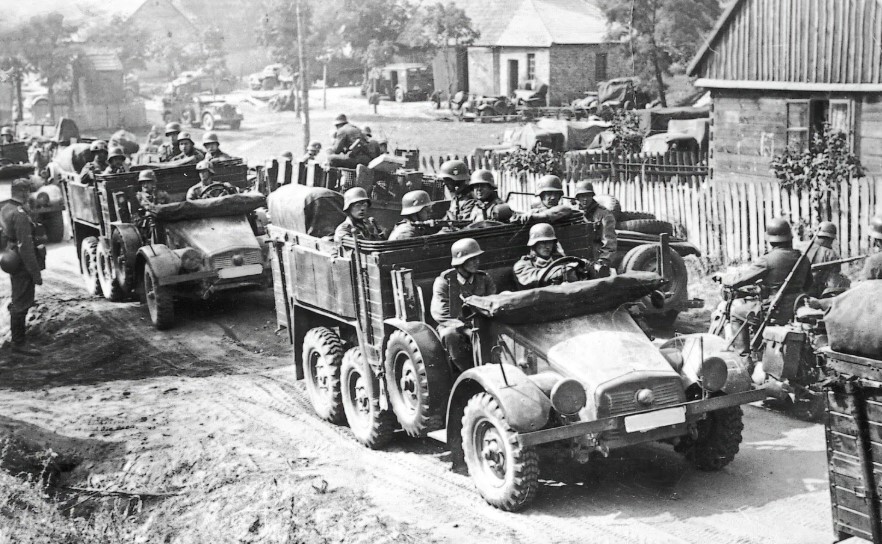
Rather than just ‘doing nothing’, Hitler ordered Nazi troops to take up ‘defensive positions, just over the border’ in Poland, 1939
Of course, Kruger – who, with utter shamelessness, was later reinvented by the Apartheid regime as some sort of champion of freedom – was never going to agree to that, and was far too pig-headed to concede an inch. Indeed, former Chief Justice of the Transvaal, John Kotzé, stated that it was Kruger’s ‘autocratic bearing and obstinate character that ultimately led to his downfall, and that of the second Republic’.[3] Kruger’s long-term political adversary, Commandant-General Joubert, agreed, admitting that the war was caused by Kruger’s ‘blind obstinacy’,[4] and said that all it would have taken to avoid it was for the Transvaal to adopt a five-year franchise law.[5]
Surely that would have been a wiser course of action than plunging the region into two-and-a-half terrible years of war?
Well, the open-minded reader might think so, but that would be to ignore two important factors:
1. Any even slightly freer and fairer election[6] in the Transvaal would have seen Kruger’s corrupt mob swiftly voted out of power.
2. Kruger’s ambitions had nothing to do with ‘preserving the Transvaal’s independence’, and everything to do with replacing Great Britain as the dominant player in the region.
And this is not some sort of ‘Jingo’s revisionist take’ on events, as the panic-stricken True Believers always like to squeal. In reality, and as well as Kotzé and Joubert, there were others in the Transvaal brave enough to raise dissenting voices in the months prior to the war – men who argued that Kruger was entirely to blame for the lack of a peaceful solution, as he knew that any change in the franchise law would mean ‘the weakening of the Kruger party’. These dissenters were demonized by the Kruger clique, however, and progressives were dismissed as ‘traitors’. One such internal critic of the Kruger regime, the prominent attorney Ludwig Krause,[7] was convinced that the cabal had ‘engineered the war as an ill-judged trial of armed strength in order that the Kruger party might remain in power’.[8]
One reason behind this determination to stay in power at all costs, was – with their snouts firmly in the trough – all the lovely money they were stealing: ‘the Transvaal ‘Republic’ is administered in the interests of a conservative clique of about three dozen families. ‘He heaps up pensions and preferments on his relatives in a way that would put Tammany Hall to shame,’ writes Mr T. A. McKenzie in his recently published pamphlet on President Kruger’.[9] It is always entertaining that those who, today, sycophantically champion Kruger as some sort of hero, are generally the same people who endlessly squeal about corruption and kleptomania in modern-day South Africa.
Syphoning off all that money was lovely, of course, but the over-riding reason the ‘Kruger Party’ desperately wanted to stay in power was, as Andrew Roberts asserts, ‘the two obstinate bearded old patriarchs, Salisbury and Kruger, both knew that this struggle was actually about ultimate regional paramountcy, about showing who was ‘Boss’ in South Africa’.[10] For Kruger, the manufactured clash with London had nothing to do with ‘independence’ (certainly not in the normal use of the word[11]), and everything to do with his determination to drive the hated Rooineks from the region – a cause he fervently believed was backed by the Almighty (of the Old Testament).[12] This was the quasi-lunatic crusade the antediluvian old troll had been planning for, and feverishly working towards, since at least the Secret Conferences of 1887.[13] So there was simply no way Kruger was ever going agree to a meaningful extension of the franchise, and risk relinquishing power to a more forward-looking, progressive, and less-violently-anti-British party.
‘Doing nothing’
But let’s indulge in a flight of fancy for a moment, and – just for shits and giggles – pretend that the oft-squawked, and wildly self-pitying, claims of the True Believers are actually true; yes, let’s throw all historical reality out of the window, and assume that there was indeed a nefarious British Government plot to invade the Transvaal (at some completely unspecified, and entirely made-up, point, sometime in the future, perhaps, maybe). Even then, from both a strategic and political point of view, Kruger’s best course of action would still have been ‘to do nothing’.
To comprehend the realities of the Boer War, one has to break free of all the indoctrination of the past, and get one’s head around the fact that there was, quite simply, no military threat to the Transvaal in late 1899. I understand that this inconvenient reality flies in the face of all the National Party propaganda that so many in South Africa so eagerly gulped down, but it is a simple fact. No meaningful numbers of British troops had been mobilised to South Africa,[14] no unusual expenditure had been authorised,[15] no plan of campaign existed,[16] no threats had been issued, and no approval for an invasion had been agreed by the Cabinet, or voted on in either the Commons or the Lords. Unlike Kruger’s Transvaal, the Great Britain of 1899 was a functioning, liberal democracy with a system of checks-and-balances; the notion that any one – least of a Colonial Office appointee on the ground – could order the invasion of another state on a whim is ridiculous.

Might this situation have been different five, ten, or twenty years later? In theory, of course it could. But that is as meaningless as frantically trying to justify Iraq’s 1900 invasion of Kuwait by claiming that, at some random and unspecified point, many years in the future, Kuwait might have tried to invade Iraq. No one would ever think to explain away Saddam Hussein’s blatant aggression in that way… yet Kruger’s similarly blatant aggression always gets a pass from those incapable of critical thinking.
We have to set all that aside, however, as in our – outrageously far-fetched – counter-factual, we are pretending that there was indeed a clear and present threat to the Transvaal in October 1899. Even in this pie-in-the-sky scenario, Kruger’s wisest response to this would have been, essentially, to ‘do nothing’ – rather than starting a war. Any mythical British invasion of the Transvaal could only have been up the route of one of two railway lines: either the one which went north east from Cape Town and up through the Orange Free State – essentially the same route as the modern-day N1 motorway; or else the one which went north from Durban, which tortuously wound its way up onto the Great Escarpment, through the imposing terrain of the Drakensberg at Laing’s Nek, and entered the Transvaal at the frontier town of Volksrust.
With this logistical reality in mind, Kruger could have insisted that his Orange Free State minions declare neutrality, meaning no British invasion would have been possible up the railway on that front – or, at least, not without causing a massive diplomatic incident, and horrifying the whole planet, including most people in Britain itself, and – most importantly – those of the Cape. One should remember that the Cape Colony of 1899 was self-governing, and there was a great deal of pro-Boer sentiment therein, including at the highest levels of government. In short, the Cape Colony was hardly the ideal launch pad for any mythical, unprovoked invasion of the Transvaal, and it is not far-fetched to suggest that any egregious breach of the Orange Free State’s neutrality could have sparked a mass rebellion against British stewardship. At the very least, the leaders of the Boer republics were confident that ‘the presence of the [Afrikaner] Bond Ministry in office in the Cape would interfere with Imperial troops making use of its railways’.[17]
With the western flank thus covered, Kruger could have focused on defending the Natal front. The bulk of the Transvaal’s forces could have dug-in on the passes at the top of the Drakensberg, and prepared the railway at Volksrust for demolition – meaning any invasion following the route of the line from Durban would have been virtually impossible.
All this exposes the weakest aspect of the desperate, and really rather pathetic, post-facto attempts to excuse and explain away Kruger’s invasion of Natal; the notion that the Boers gave up these incredibly formidable defensive positions – described as being ‘ideal terrain for the Boers’, and ‘immensely strong’ by British army Intelligence reports[18] – so as to take up unspecified ‘better’ ones, deep inside Natal, is utterly fanciful. In fact, this is so ridiculous that those pushing this nonsense clearly have an agenda, and cannot be considered to be objective, or, indeed, to have the first clue about military matters.
Why, one might reasonably ask, do their modern-day fan boys think that invading British territory was a better way to ‘defend their republic’ than simply, well, just digging in on the border and, err… actually ‘defending their republic’? As I have already stated, the best defensive terrain was on the frontier with Natal, and thus there was absolutely no strategic benefit in giving this up, and instead invading. Not only was the notion of grabbing Durban so fanciful as to be discounted, but – even had it happened – would have achieved nothing. Had Durban (by some miracle) fallen, there was nothing to stop the Royal Navy simply landing troops at a dozen other ports instead. Indeed, even had the British lost every single port in South Africa – and, yes, now we are really being silly – they could still have requested that their Portuguese ally allow them to land an invasion / liberation force at Lourenço Marques.
Also – and though it is much-loved by slack-jawed, crayon-eating True Believers – the whole myth of the invasion being a ‘pre-emptive’ strike is utterly ridiculous for several reasons. Firstly, it did not ‘pre-empt’ anything, as no British invasion was imminent, or even vaguely on the horizon – thus it completely fails the Caroline test, as I have explained in previous articles.[19] Secondly, other than Kruger’s blatant Empire building, there was no logical military objective: a genuine pre-emptive strike would normally be aimed at shattering or isolating a troop concentration, knocking out a critical bridge, or – in modern times – destroying air power while still on the ground. A mass, full-scale invasion of 40,000 men on two fronts is patently not a ‘pre-emptive’ strike, no matter how the Apartheid-era propagandists desperately attempted to reinvent it; it is, quite simply, an invasion.
To pretend this was a ‘defensive’ endeavour is mind-blowingly stupid on so many levels. By gleefully abandoning their textbook defensive positions on the Drakensberg, the invading Boers lengthened their supply lines, and acquired thousands of square miles of enemy territory which would need to be policed and administered. We are asked to believe that the innocent, peace-loving invaders swapped the incredible natural defences of the Drakensberg for… well… err… basically wherever they happened to get to before the British fought the invasion to a standstill – positions which would, several decades later, be shamelessly reinvented by a couple of failed History Professors, desperate to pretend that these just so happened to be the objectives of the invasion all along. Furthermore, by invading Natal and the Cape Colony, the Boers suddenly didn’t just have the British army to worry about, but also had to take on the local Natalian volunteer forces[20] – excellent regiments like the Natal Carbineers, Natal Mounted Rifles, and Border Mounted Rifles, were only deployable for the defence of their colony, and thus would not have been available for any mythical invasion of the Transvaal.
And, if all poor old, innocent and misunderstood Kruger ever wanted was to ‘defend his independence’, invading British territory to do so was also utterly brainless for non-military reasons. Let’s assume that, fearing a British invasion, the Transvaal Boers had dug-in on the top of the Drakensberg passes, but were otherwise ‘doing nothing’. Had nasty old Britain then declared war and invaded, Kruger would (quite rightly) have enjoyed the sympathy and support of the vast majority in the (Afrikaans-dominated) Cape Colony, and even many in (staunchly-loyal) Natal. Furthermore, it is highly unlikely there would have been the same enthusiasm across the rest of the Empire (or even in the Motherland) to rush to the colours, had Britain actually been the aggressor in the war, rather than (in reality) the defender of Natal and the Cape Colony.
A sense of fair play[21] and support of the underdog[22] are widely accepted as deeply engrained parts of British culture, and thus it stands to reason that the issue of culpability mattered greatly when it came to attitudes at home, and across the Empire. In reality, HM government were, in the words of Leo Amery, ‘determined to do nothing that could possibly be construed as a desire to force a war upon the Transvaal, before exhausting every resource of diplomacy, and refused to mobilise an army corps or even to sanction any expenditure on preparations which they knew could not be kept secret. Militarily, and probably diplomatically, their decision was unsound. Politically it was wise. The Government had a righteous cause, and were exceedingly anxious to do nothing that could put that cause in the wrong in the eyes of moderate men, whether among English Liberals, in the British Colonies, or even among the Dutch population of Cape Colony and the Orange Free State’.[23]
Furthermore, and perhaps needless to say, had the Transvaal really been the victim of an unprovoked British invasion in late 1899, the other Great Powers of the Age – Germany, France, Russia, the United States, Austro-Hungary, Italy, Japan etc – would all have been much more passionately, and perhaps even actively, on the side of Kruger. Great Britain was still the greatest of the Great Powers, but with Germany and the United States rapidly catching up, she certainly did not exist in a vacuum. Additionally, in 1899, Britain was the world’s foremost industrial and trading nation, a system that depended entirely on the model of unhindered free-trade. The very last thing London wanted was to have the whole world turn against it, and suddenly stop buying British goods, supplying her with raw materials or – potentially – even targeting her merchant shipping.
And disruption to trade and supply did not necessarily have to be direct military action, or even need to be sanctioned by foreign governments. In 1920, dockers in London’s East End refused to load the SS Jolly George with munitions destined for Poland, which was at war with Bolshevik Russia.[24] The strike, which was backed by the ‘Hands Off Russia’ campaign, successfully stopped the British government from aiding military interventions aimed at crushing the Soviet revolution. In the wake of an unprovoked British invasion of the Transvaal, it is not impossible to imagine similar acts of ‘solidarity’ at ports both in Britain and across the globe.
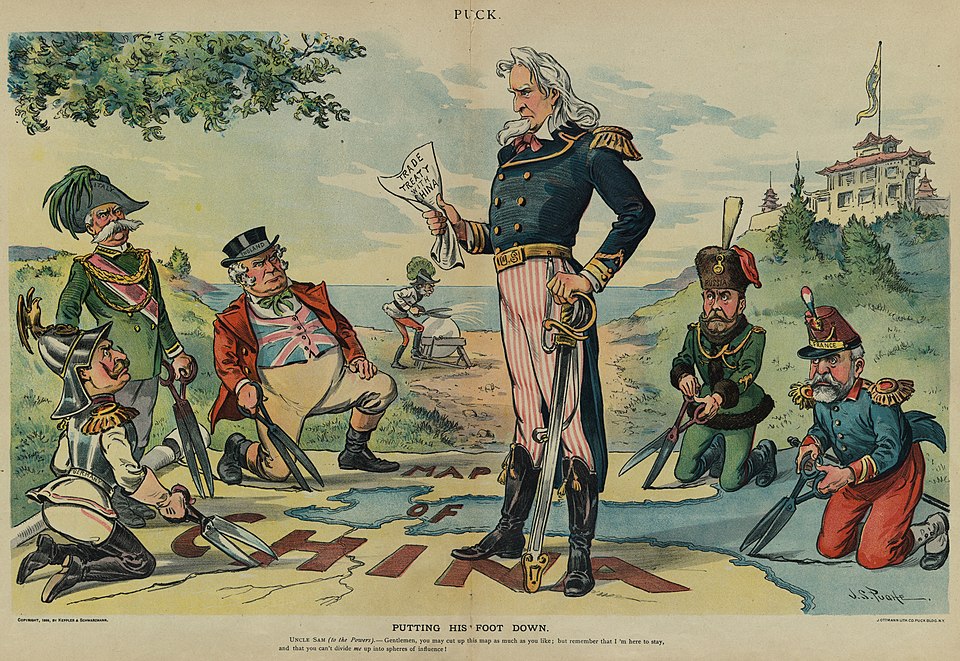
The notion that the Britain of the age could (or would) simply do anything she wanted is nonsense, and there was always dialogue, engagement and compromise between the Great Powers. One only has to look at the Venezuelan crisis of 1895, the Anglo-French Convention of 1898, or the ‘Entente Cordiale’, to see how things were handled diplomatically and cooperatively – rather than just buying into this far-fetched notion of the nasty British bully stamping about, doing whatever she pleased, and grabbing whatever she wanted.
Given the Royal Navy’s still undisputed control of the waves,[25] it is highly unlikely that any other nation could have directly intervened in military support of the Transvaal. But it is not entirely implausible that, in this hypothetical atmosphere of (entirely justified) anti-British rage, the other Great Powers might have seized their moment to settle a couple of old scores, or snatch disputed territories while John Bull was otherwise engaged. The mere prospect of an American threat to Canada, a Russian threat to India, a French threat in North Africa, or German-backed rabble-rousing in Britain’s Middle Eastern possessions, would certainly have diverted all London’s attention back away from the Transvaal.
So yes, ‘doing nothing’ – as in, ‘not starting a war against the greatest power on the planet’ – would absolutely have been a wiser course of action for Kruger. Indeed, the only better course of action he could have taken would have been to defuse all the tensions in the region by granting a fair franchise to the Uitlanders, and thus bringing the Transvaal into line with the rest of southern Africa.
Alas, Kruger was too stupid and naïve to do the first; and too drunk on power, and too obsessed with his crackpot ‘crusade’, to do the latter.
NOTES:
[1] To be fair, this might not have been meant sarcastically – it is not always easy to pick up on nuance over text. And he did have the best screen name I’ve ever seen: ‘The Grand Panjandrum’
[2] https://www.chrisash.co.za/2026/06/01/could-botha-ever-really-have-eaten-those-bananas/
[3] Kotzé, Memoirs and Reminiscences, p.32
[4] Nasson, The War for South Africa, p.36
[5] Pakenham, The Boer War, p.104
[6] By ‘freer and fairer’, I mean with the vote extended to the Uitlanders, Jews and Catholics – there was zero chance of a racist old troglodyte like Kruger ever agreeing to a colour-blind franchise, like that in Britain’s Cape Colony. And yet this ghastly Flat-Earther cretin is a hero to the various online Defenders of the Myth… nice people
[7] In his book, The War for South Africa, Nasson stops short of calling Krause a ‘traitor’; however, he does declare him to have been a ‘bilious anti-Kruger progressive’ – I mean, what could possibly be worse!?
[8] Nasson, The War for South Africa, p.36
[9] North American Review, Vol.170, Number 520, March 1900, p.329
[10] Roberts, Salisbury – Victorian Titan, p.732
[11] It is always amusing that True Believers – including their High Priests – genuinely seem to think that the word ‘independence’ means: ‘continued corrupt rule by a recently-arrived minority, comprising members of a self-appointed master-race’
[12] Nathan, Paul Kruger, p.447
[13] John Fraser, Episodes of my Life, p.145-147
[14] Some two months after the failed Bloemfontein Conference, at which Kruger rejected Milner’s proposals, just two battalions were ordered to deploy to south Africa
[15] Walker, A History of Southern Africa, p.478
[16] Minutes of Evidence taken before the Royal Commission on the War in South Africa, Vol.1, p.429
[17] Farrelly, The Settlement After the War, p.183
[18] Maurice, History of the War in South Africa, Vol.1, p.40
[19] https://www.chrisash.co.za/2026/05/01/sweet-caroline-the-myths-never-seemed-so-wrong/ and https://www.chrisash.co.za/2017/12/16/a-war-of-aggression-portrayed-as-a-war-of-necessity/
[20] Interestingly, the case of the Cape Colony volunteer forces was rather different. By their terms of enlistment, the Cape volunteer regiments were liable for service ‘wherever the interest of the Colony may require, within the Colony or beyond its borders’. See the Cape Colony Volunteer Act 1892 (amended 1895), p.3115
[21] https://www.alumni.ox.ac.uk/article/fair-play-as-national-character-the-british-case-examined
[22] https://www.bbc.com/news/av/entertainment-arts-11766450
[23] Amery, The Times History of the War in South Africa, 1899–1902, Vol.2, pp.99–100
[24] https://www.counterfire.org/article/jolly-george-and-revolutionary-russia/
[25] The Naval Defence Act 1889 had dictated that the Royal Navy must maintain a fleet at least equal in size and strength to the combined forces of the next two largest navies in the world (France and Russia) This was often referred to as the ‘Two-Power Standard’ – a far cry from today’s decimated and aging fleet

2 Comments
It wasn’t meant sarcastically at all – but I now see it came across that way. I think you make an excellent argument and cannot fault any of it. It was completely in Kruger’s hands whether or not there would be a war. And he decided there would be.
My apologies in that case!
Still, at least the comment gave me an idea for an article. And yes: whether or not there would be a war was entirely up to Kruger. He stupidly decided to start one, and the rest is history.
Add Comment