

We had fired our salvo, and the Finns had replied with artillery fire of their own. De facto, the war had begun. There is, of course, another version of the facts: it’s said that the Finns started shooting first and that we were compelled to shoot back. It’s always like that when people start a war. They say, ‘You fired the first shot’, or ‘You slapped me first, and I’m only hitting back’.
Writing about the 1939 Winter War, Soviet premier Nikita Khrushchev was remarkably candid about the excuses unpleasant regimes use to justify invading their neighbours[1]

The 1939-40 Winter War: another so-called ‘defensive invasion’ which didn’t go quite to plan
I have hundreds of books about the Boer War, including plenty of more modern ones which fall over themselves to push that fantasy that Kruger’s long-planned invasions of British territory were somehow ‘pre-emptive acts of self-defence’. Of course, this post facto nonsense was dreamt up, and is churned out, for the sole reason of explaining away the awkward fact that the Boers started the war. Such rubbish shamelessly plays to those in the cheap seats, going down well with the unwashed True Believers – mouth-breathing fanatics who can be trusted never to scratch the surface of this (completely baseless) claim.
A rogues’ gallery of failed History Professors, sycophantic hangers-on, knaves, fools, and assorted toadies, have faithfully trotted-out this preposterous excuse in their books over the years (a trend which caught on, funnily enough, during the Apartheid era). Alas, this absurd myth has been repeated so often that it is eagerly, and unthinkingly, accepted as Gospel by those who desperately want – need? – for it to be true.
With this in mind, it is remarkable that I have yet to see a single one of this gaggle of charlatans take the time to explain how Kruger’s (ahem) ‘pre-emptive’ invasions meet the ‘Caroline test’.[2] Taking its name from that of an American steamboat which was destroyed before it could ship guns across to rebels in Canada, this is a customary international law dating from the 19th century. It was reaffirmed by the Nuremberg Trials after World War II[3] – as the Axis powers also belatedly attempted to spin their invasions as being ‘pre-emptive’. What lovely company Kruger’s modern-day apologists choose to keep.
Whether today’s Kruger fan-boys like it or not, the Caroline test remains the foundational, and widely accepted, legal standard in international law for determining the legitimacy of anticipatory pre-emptive self-defense; basically, if a given attack does not meet the standards of the Caroline test, it cannot be justified as legitimate pre-emptive action. It would thus seem strange that this horde of writers and alleged academics are blasé enough to airily pronounce Kruger’s 1899 invasions of British territory as ‘pre-emptive’, without referring to the relevant piece of international law at all. Indeed, I cannot recall ever having seen the Caroline test mentioned in any of their so-called histories of the conflict. Yet one of the most important myths of the Boer War – the corner stone of all the victimhood fantasies, no less – is that, despite starting the conflict by invading their neighbours, the Boers were (somehow) absolutely and definitely not the aggressors. Perish the thought.
Anyone with an agenda and an axe to grind – especially a dusty, embittered academic relic of a previous regime – can declare an attack to have been ‘pre-emptive’… but this does not make their preferred fiction true. To normal, educated people, this reality is so self-evident that it should not even need to be stated. Alas, when dealing with True Believers, however, one has to make things very clear, so let’s use a rather more prosaic example; imagine two neighbours are arguing about a tree shedding leaves over the fence into one’s garden. The aggrieved fellow cannot just kill his neighbour, then, simply by declaring this attack to have been an act of ‘pre-emptive self-defence’, be automatically accepted as the innocent party in the affair. Obviously, no one would unthinkingly take the killer’s word for this. Indeed, only an idiot would take this far-fetched assertion seriously. To attempt to make such a case, he would need to somehow explain how this killing met the accepted legal standard of self-defence or pre-emptive action, and refer to the relevant laws and precedents which he is trying to use to support his (highly implausible) position.
It stands to reason that those frantically hiding behind the fig leaf of ‘pre-emptive self-defence’ – whether to excuse the killing of the bloke from next door, or to explain away the invasion of neighbouring territory – should provide at least some legal justification to support these claims, rather than hoping that their slack-jawed readers will just nod along, and not think to remove their blinkers. Basically (unless you are a fanatic who just wants to keep Apartheid-government myths alive), if one makes such an outlandish claim, then one really has to then explain how this meets the established and accepted laws pertaining to the right to self-defence and pre-emptive action.
So there must be a pretty good reason why all the books which were (and still are) spewed out to defend the NP myths around the Boer War, and which fall over themselves to claim that Kruger was the innocent victim in the war he started, entirely fail to mention the Caroline test.
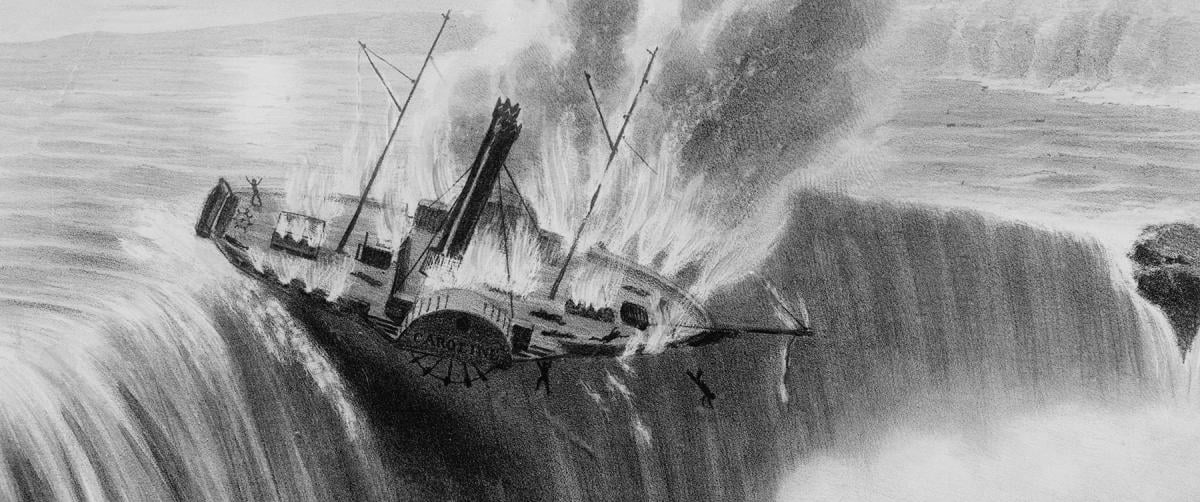
Ablaze from bow to stern, the gun-running Caroline is pitched over Niagara Falls in 1837
It is – I suppose – just about possible that not a single one of the ‘academics’ responsible for this farrago of lies and propaganda has ever heard of the international law which specifically addresses pre-emptive attacks; though that would certainly make one wonder about the standard of education offered at the likes of Stellenbosch and Pretoria Universities. Such lack of knowledge would obviously prove these so-called academics to be completely ignorant about the field they choose to lecture in / write about – but at least ignorance is rather better than willful, duplicitous chicanery.
However, it is rather more likely, I would suggest, that these supposedly-learned fellows are well aware of the Caroline test. But, rather inconveniently for them, they are equally aware that Kruger’s invasions would most certainly not qualify as legitimate and justifiable pre-emptive attacks by the standards it sets out – or, indeed, even come close to so doing. And so, in all the books they still churn out in support of National Party propaganda, they have deceitfully, and completely, air-brushed the Caroline test out of the picture… and desperately prayed that no one will think to bring it up.
Yes, you read that correctly: those who are so anxious to explain away the Boer invasions of British territory by pretending they were acts of ‘pre-emptive self-defence’, are the same people who do not want their readers knowing the standards that customary international law uses to determine such things. This certainly suggests they know full well their claims are utter rubbish, but such – it would seem – is their complete lack of integrity.
Little wonder their instinctive response to my writing, and the fresh perspective I dare to bring to the subject, is sheer, unadulterated, panic.
For those who are unaware – including, or so we are asked to believe, even some of those who lecture in Military Science or History at various South African universities – the operative phrase of the Caroline test was that the necessity for pre-emptive self-defence must be ‘instant, overwhelming, and leaving no choice of means, and no moment for deliberation’. This was later refined to: ‘an instant and overwhelming necessity’.[4] Furthermore, to ‘pass’ the Caroline test, any pre-emptive strike must also meet two distinct requirements:
1. The use of force must be necessary because the threat is imminent and thus pursuing peaceful alternatives is not an option (ie. necessity)
2. The response must be proportionate to the threat (ie. proportionality).[5]
None of which even remotely describes Kruger’s situation in October 1899, let alone his actions in the years leading up to his starting the Boer War.[6] Any military ‘threat’ to the Transvaal in October 1899 was certainly not ‘imminent’ – indeed, it was, for all intents and purposes, non-existent. Even had the British been ‘massing’ invasion forces on Kruger’s borders (which, as we shall see, they most certainly were not[7]), responding to this by launching ‘pre-emptive’ attacks aimed, not at disrupting or isolating such non-existent forces before they could strike, but instead at capturing and annexing all of Natal, Bechuanaland, Griqualand West, and most of the Cape Colony, would by no means be considered a ‘proportionate’ reaction to this supposed threat.
‘Necessity’
As the aforementioned need to reaffirm the long-standing Caroline test at the Nuremberg Trials suggests, the attempt to explain away blatant acts of aggression by claiming them to be ‘pre-emptive’ or ‘defensive’ attacks has been used by plenty of other unsavoury people and regimes throughout history.
In the 1930s, Imperial Japan portrayed its acts of aggression against China as ‘self-defense’ or ‘pre-emptive’ in laughable attempts to justify its endless expansionism. The 1931 Mukden Incident[8] was cited by Tokyo’s propagandists as proof of Chinese aggressive intent, for example, but this nonsense was dismissed by a League of Nations report compiled the following year. An international commission, headed by Lord Lytton,[9] did not explicitly declare the Mukden Incident to have been a false-flag operation, but stated the operations of the Imperial Japanese Army in response to it could not be possibly be regarded as legitimate self-defence.
Similarly, few would take seriously the German claims that their 1939 invasion of Poland was also a ‘pre-emptive act of self-defensive’. With utter shamelessness, the attack was even referred to in Germany as the ‘1939 Defensive War’ (Verteidigungskrieg). In reality, on 22 August, Hitler informed his generals that he would, ‘provide a propagandistic casus belli. Its credibility doesn’t matter. The victor will not be asked whether he told the truth’.[10] Sure enough, his propagandists had launched ‘Operation Himmler’ in the weeks prior to the invasion, with the purpose of creating the appearance of looming Polish aggression against Germany. Anyone with a functioning brain knew this to be utter nonsense, but it would nevertheless be used to justify the German invasion of Poland, and give it the veneer of being a pre-emptive / defensive invasion.
The 1940 German invasion of Norway is another example, and the Caroline test was specifically used to disprove later attempts to pretend that this too was pre-emptive. At the 1946 Nuremburg Trials, the German defence team argued that Germany was ‘compelled to attack Norway by the need to forestall an Allied invasion and that her action was therefore preemptive’.[11] Unsurprisingly, this was not found to have met the criteria of the Caroline test, and the prosecution pointed out that Germany had been preparing plans for an invasion of Norway long before there was any thought of British and French troops moving to secure it (just as Kruger and his goons had been plotting for an attack against the British Empire since at least the Secret Conferences of 1887[12]). Furthermore, the Court found that Germany faced no ‘imminent’ threat from Norway, and thus it failed the Caroline test completely.[13]

Another make-belief act of ‘pre-emptive self-defence’: Nazi troops invade Norway in 1940
Amazingly, even Hitler’s 1941 invasion of the USSR is excused by some fanatics as a ‘pre-emptive strike’, launched in the nick of time and only because Stalin was planning to do exactly the same to peaceful and benign, completely innocent Nazi Germany.[14] Despite the fact that Stalin was an unelected, psychopathic dictator, that the USSR had recently invaded and annexed the Baltic States, plus parts of Finland, Poland and Romania, and that hundreds of thousands of Red Army troops were indeed near the border, other than a few neo-Nazis, no one takes this attempted whitewashing of Hitler’s blatant aggression seriously.[15]
And yet, if anything, the notion that the Boer invasions of 1899 were legitimate ‘pre-emptive’ attacks, done only for reasons of ‘self defence’, is even more ludicrous than the claims of Nazi Germany and Imperial Japan. The phrase suggests, of course, that poor, misunderstood Kruger had absolutely no choice but to invade, so as to ‘pre-empt’ an imminent British attack – as though a dozen imperial divisions were poised on the frontier, threats had been issued, and the republican leadership had intelligence reports confirming an invasion could happen that very day.
Needless to say, and despite the rubbish True Believers like to tell one another,[16] this quite simply was not the case; even just a few weeks before the Boers invaded, the British were still blissfully oblivious to the storm that was brewing on the other side of the frontier. The officer commanding Her Majesty’s troops in South Africa, Lieutenant-General Sir William Butler,[17] had ‘been informed that there was no special reason to fear immediate war and was ordered to curtail long-authorized military expenditure’[18] and though the Rhodesian authorities asked the imperial government for arms, the War Office continued to cut down establishments.[19]
Michael Farrelly,[20] a brilliant Irish barrister who served as advisory counsel to the government of the Transvaal in the late 1890s, was uniquely placed to clearly see that Kruger had been preparing to attack the British Empire for years. Luckily, Farrelly left us a magnificent first-hand account of the run up to the Boer War – an account which is, of course, completely ignored by Pakenham and the High Priests of National Party Myth. In these memoirs, Farrelly related how, in early 1899, he tried to warn many of the leaders in British South Africa: ‘Among those whose views I sought were the governor of Natal, Sir Walter Hely-Hutchinson, and the acting high-commissioner, [General] Sir William Butler; the leading members of the past and the present governments, and of the legislative bodies, as well as of leading lawyers, of leading merchants, and landowners in Natal, the Eastern Province and the Cape. With only two exceptions, I was assured that the prospects of war between the two Boer States and the Empire, or between Dutch and British in South Africa, were so remote that no sensible man would think about them.’[21]
And when – just a few weeks before the Boers invaded – a group of prominent Uitlanders approached Butler, offering to raise a regiment of light horse from those expelled from / fleeing Johannesburg, the General replied: ‘England is not preparing for war, even if the Transvaal is preparing’[22] – which is about as emphatic as it gets.
Though not quite as blind to the threat from the republics, the Generals who succeeded Butler were no more aggressive. General Sir George White[23] – on his way to take up command in Natal – had initially planned on responding to the anticipated invasion by abandoning the north of the colony and pulling back to hold positions on the Tugela River.[24] In contrast, it should be noted that, not only did the British Army have no invasion plans in place, but there were no plans for campaign in South Africa at all. Do please read that again, and let it sink in… and bear in mind that it comes directly from General White himself, who later reported the situation to Lord Roberts: ‘When I arrived in Natal, I had no instructions in regard to the wishes of the government as to any particular plan of campaign, nor was I aware of any general plan of operations in South Africa.’[25]
Furthermore, Sir George was not the only one who, with a Boer invasion imminent, advocated the abandonment of the whole of Klip River County,[26] including Dundee and Ladysmith, and instead withdrawing all imperial forces back behind the Tugela.[27] General Sir Redvers Buller[28] – who served as commander-in-chief, arriving in South Africa a few weeks into the war – also initially adopted a similar position,[29] stating that it was essential White should not push his small garrison close to the Transvaal, and should instead withdraw take up defensive positions along the Tugela.[30]
Colonel Sir Henry Rawlinson,[31] who served on White’s staff throughout the Siege of Ladysmith,[32] took the same line and noted this in his diary on 7 October (ie. 4 days before the Boers invaded):
It is my conviction that if Natal is to be defended successfully with the forces we have available, against an enemy greatly superior in numbers, and armed with modern weapons, the only thing to do is to hold the line of the Tugela and give up Dundee and Ladysmith altogether. But I understand that the Governor will not hear of our leaving even Dundee. He is afraid of the moral effect of a retirement on the Boers in the Cape Colony, and on the natives. The native problem is one with which we are faced wherever we go, and it is a difficult one, but we should not allow it to force us into false positions. It seems to me that the effect on the natives will be much greater if we are driven back than if we fall back. If we don’t go back to the Tugela we shall be roughly handled.[33]
Indeed, as late as 22 September, Sir George White had a requisition for expenditure on transport refused[34] and, such was the sheer disbelief with which the republican attack was greeted, that the troopers of the Natal Mounted Police were ordered not to fire on the Boer invaders unless they were themselves fired upon.[35]

In October 1899, the only ‘imminent threat’ on the Natal Front was from the Boers
So much for the self-serving Apartheid-era myths of there being a vast British Army ‘massed on the border’, and poised to invade the republics at any moment. What is especially sad is that so many in South African academia still desperately peddle these fairy stories.
Anyone with an open-mind, and more than half a brain, will agree that all this is about as far from an ‘imminent threat’ as it is possible to imagine. As well as the British Army having no invasion plans, the generals in command were even proposing pulling their small, outnumbered garrison still further back away from the republics. Put simply, the Boers’ (ahem) ‘pre-emptive, defensive invasion’ was not, in reality, pre-empting or defending against anything – meaning it would not even come close to meeting the standards of the Caroline test.

And it was the same on the Western Front – with the outnumbered British forces scattered in penny-packets to protect railway junctions and hold a couple of towns, the only ‘massing on the border’ was by the Boers
Aside from the political ramifications of abandoning the whole of Klip River County to the invading Boers, that General White ultimately decided against a retreat behind the Tugela was mainly due to the strategic importance of Ladysmith itself. As tactically difficult as it was to defend, Ladysmith nevertheless had strategic value as it controlled the railway lines entering Natal from both the Orange Free State and the Transvaal.[36] As long as the town remained in British hands, the invading republicans would have no usable common railway junction in Natal, and their push towards Durban would have to rely entirely on wagons for support. What is more, had Ladysmith been abandoned to the Boers, White’s small imperial garrison would have had to try to defend some 100 miles of the Tugela – from the Drakensberg to the Buffalo River. Not only was the commanding ground generally on the northern bank of the river,[37] but the paucity of forces available would have meant only a few drifts could have been held by scattered, isolated, and difficult-to-supply detachments.[38]
‘Proportionality’
One of the main tenets of the Caroline test is that, even if justified, a pre-emptive strike must also be proportionate to the threat. Or, as one writer on the topic put it, ‘If one country prepares to raid a border town and steal thousands of dollars of property, the threatened country should not nuke the invader’s capital city… the defensive action cannot exceed the force that would be used in the imminent aggression. For example, an attempt to bomb an airbase can be met only with a preemptive bombing of the aggressor’s military base, not a total elimination of the aggressor’s military infrastructure’.[39]
To use a real life example – and one of the very few attacks which is generally accepted to have come close to meeting the criteria of the Caroline test – 1981’s Operation Opera saw Israeli F-16s bomb the almost-finished Osirak nuclear reactor a few miles outside Baghdad. This caused a degree of diplomatic consternation at the time, with many observers pointing out that, with the reactor still not complete, Israel did not face an ‘imminent’ threat, and thus there was still time for a diplomatic solution.[40] Nevertheless, the Israeli response to the perceived threat was to destroy the reactor, not to invade and annex all of Iraq – meaning that few dispute the strike at least met the ‘proportionality’ aspect of the Caroline test.

A proportional response to a non-imminent threat? Israeli F-16s destroy Iraq’s Osirak nuclear reactor in 1981
To put this into the context of the Boer War, we shall have to indulge in a flight of fancy. Let’s assume for a moment that the situation in October 1899 was that HM Government had issued a direct threat of invasion to the Transvaal, and that large numbers of British troops were massing in Charlestown, at the top of Laing’s Nek Pass and right on the Natal border with the republic. Had the Boers mounted a raid into Natal just before this mythical British invasion was launched, so as to blow up the railway line behind these forces, then this would most-likely be considered a proportional response to this (entirely hypothetical) threat.
However, and in stark contrast, what really happened in 1899 was completely different.
As the maps above illustrate, not only were there no British troops ‘massed’ on the frontiers, ready to attack, but the republican invasion of British territory was by no means a ‘limited’ affair, and cannot possibly considered to have been ‘proportional’ to the make-belief threat. As early as June 1899, British military intelligence had learned that: ‘the vague designs of the Boer governments against Natal, of which the British Intelligence department had had cognizance in the previous year, were taking definite shape, and that, at any rate, so far as the Transvaal forces were concerned, the eastern colony [as opposed to Cape Colony] would probably become the main object of their attack’.[41]
All in all, probably the best description of Kruger’s war aims comes from General Maurice’s History of the War in South Africa. This four volume[42] ‘bible’ of the Boer War should be required reading for all those with any interest in the conflict, so I make no apology for quoting it at length:
The main strength of the enemy had been concentrated for an invasion of Natal. The President hoped that it would sweep that colony clear of British troops down to the sea, and would hoist the Vierkleur over the port of Durban. Small detachments had been told off to guard the Colesberg, Bethulie, and Aliwal North bridges and to watch Basutoland. On the western frontiers of the Transvaal and the Free State strong commandos were assembling for the destruction of Baden Powell’s retaining force at Mafeking and for the capture of Kimberley.
Both Kruger and Steyn aimed at results other than those achieved by the initiatory victories of 1880-1. They cherished the hope that the time had come for the establishment of a Boer Republic reaching from the Zambesi to Table Mountain; but, for the accomplishment of so great an enterprise, external assistance was necessary, the aid of their kinsmen in the south, and ultimately, as they hoped, an alliance with other Powers across the seas.
The authorities at Pretoria and Bloemfontein realised fully that, though they might expect to have sympathisers in the colonies, active cooperation on any large scale was not to be counted on until successes in the field should persuade the waverers that, in casting in their lot definitely with the republican forces, they would be supporting the winning side.
The conquest of Natal and the capture of Kimberley would, it was thought, suffice to convince the most doubtful and timid. As soon, therefore, as the British troops in Natal had been overwhelmed and Kimberley occupied, the Boer commandos in the western theatre of war were to move south across the Cape frontier to excite a rising in that colony. A situation would thus be created which, as they calculated, would lead to the intervention of one or more European Powers, and terminate in the permanent expulsion of all British authority from South Africa.[43]

Advancing about 150 miles from their start line in over six weeks, Kruger’s invasion only ended after the Battle of Willow Grange. There was nothing at all ‘limited’, ‘proportional’ or ‘defensive’ about the Boer invasion of Natal
Obviously, these grand schemes of empire-building are about as different from a ‘proportional, pre-emptive self-defence against an imminent threat’ as it is possible to be. Of course, the trademark, knee-jerk response of the Defenders of the Myths to this inconvenient reality will be to wave away Maurice, and squeal that he is a ‘jingo’ – ie. anyone who dares to say something that doesn’t align with their fantasies of victimhood. So, with that in mind, let’s also look what the Boer leaders said.
After the war, none other than General Jan Smuts himself – the man who finalised the plans – told his biographer (and son) that the aim of invasion of Natal was ‘to strike down swiftly at Durban and the other ports upon the outbreak of hostilities, in order to prevent the British landing reinforcements. That phase completed, the mopping up of troops in the country would begin’.[44] A glance at the map will show that this would have involved overrunning the colony pretty much in its entirety – far from the ‘limited’ (proportional?) incursion some have rather desperately reinvented it as today. Indeed, Smuts talked in blatantly aggressive (and highly inconvenient) terms: ‘Whether we conquer or whether we die … Then it shall be from the Zambesi to Simon’s Bay: Africa for the Africander.’[45]
Not only that, but one of the men who led the (unsuccessful) drive on Durban, General Louis Botha, had assured Kruger that the Transvaal’s flag would soon ‘wave over a free harbour’.[46] He would later claim that only General Joubert’s timidity had prevented him from ‘coming to Durban to eat bananas in 1899’[47] – which sounds like an excellent title for a book. Again, and as inconvenient as they are for today’s Kruger apologists, there was nothing at all ‘proportional’ in these clearly stated objectives.
Colonel Villebois-Mareuil[48] was a French mercenary who fought for the Boers. He enjoyed personal contact with President Kruger, would be promoted to the rank of general,[49] and worked closely with Joubert, Cronjé, and Botha. Known as ‘the French Colonel’, he wrote that republican war aims were ‘simply a matter of grabbing back the whole of South Africa from the British … a case of the hatchet in the big oak’.[50]
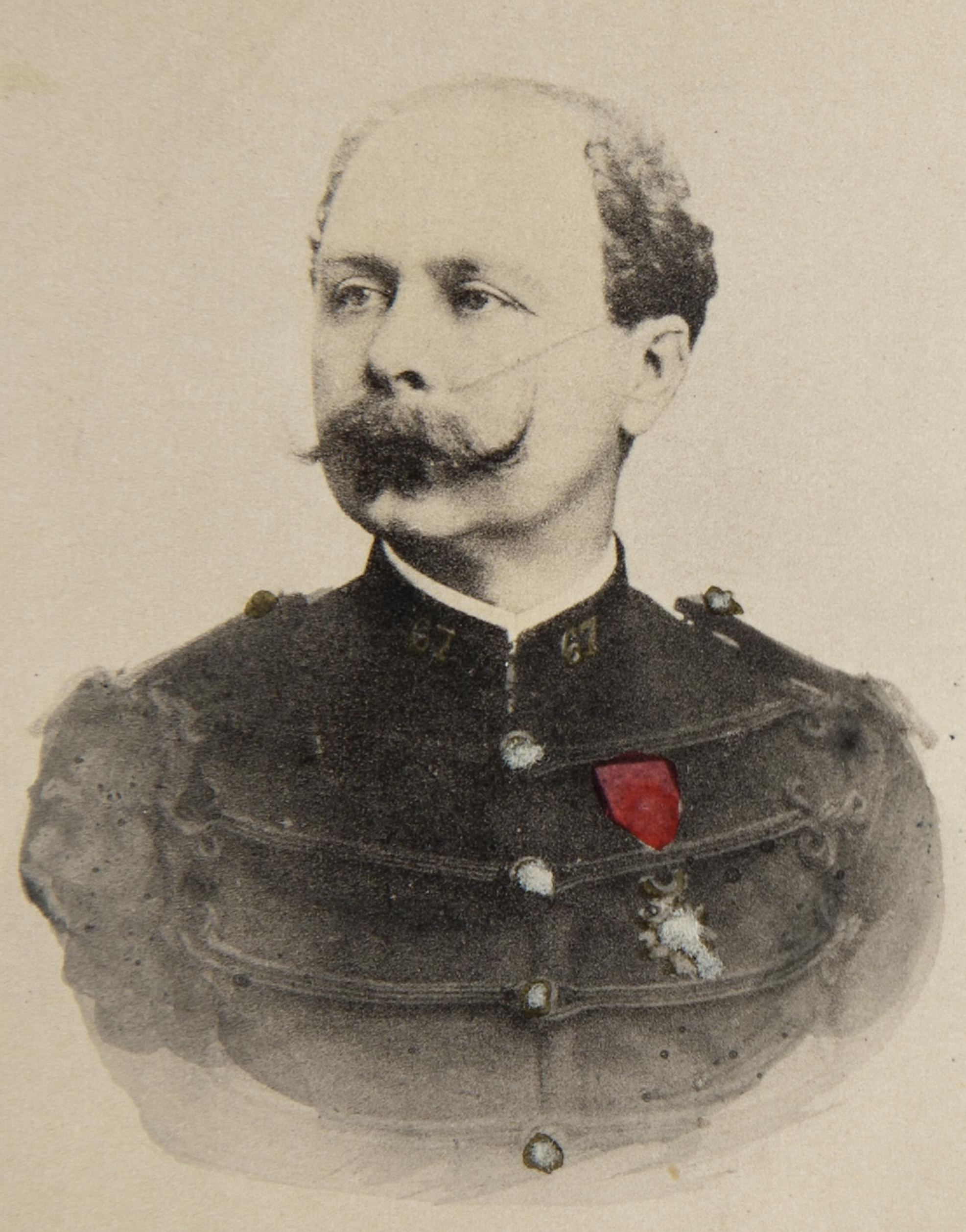
‘The French Colonel’ – Georges Henri Anne Marie Victor de Villebois-Mareuil
Hardly what one could call an ambiguous statement and – again – not something that fits with the post facto pretence that Kruger’s invasion was ‘limited in nature’, or would meet the ‘proportionality’ criteria of the Caroline test. Indeed, the only reason the Boers’ latter-day apologists could frantically attempt to spin it as a ‘limited invasion’ was because it failed so dismally. However, the fact that the invading Boers proved incapable of taking British-held towns does not equate to Kruger’s long-planned invasions being ‘proportionate’ or made ‘in self defence’; the fact that Germany’s invasion of the USSR also failed does not lead any rational person to claim it was therefore in some way justified.
And if the words of these Boer generals are not enough, Kruger himself also admitted the aim of his invasion to Count Adalbert Graf Sternberg, an illustrious Austrian war correspondent. Sternberg travelled to both Pretoria and Bloemfontein in December of 1899, in a quest to ‘discover the ultimate objects of the Boers’, and spent a good deal of time with Kruger, a man he appears to have admired. Tellingly, he reported that ‘Kruger himself only wanted Natal, with the port of Durban’[51] – of course, ‘only’ wanting to steal an entire British colony is bad enough, and also suggests that some of his circle wanted even more. Either way, this completely torpedoes the notion of the invasion being ‘limited’ or ‘defensive’, or that it was in any way a ‘proportional’ response to the (complete lack of a) threat to the Transvaal.
Though they are always desperate to pretend the Boers invasions were ‘pre-emptive’ acts of ‘self-defence’, that is precisely why you will never find any mention of the Caroline test in any of the hundreds of books and papers spewed out by any of the Defenders of the Myth – just as they also studiously overlook the likes of Farrelly’s first-hand account. One might think it strange that the True Believers choose to ignore the very aspect of customary international law which would (supposedly) support their case, but the reasons for this startling omission are obvious; for all their duplicity and pig-ignorance, the High Priests of the Myths are nevertheless ‘slim’ enough to know that, if an open-minded reader takes a moment to compare their self-serving fantasies to the criteria required to meet the Caroline test, then the Boer republics are clearly proven to have been the aggressors in the war.
And with that undeniable reality accepted, all their comforting-though-nonsensical myths of Boer victimhood come crashing down… along with the tattered remains of their academic reputations. For these fruitcakes, fanatics, fantasists, and nostalgists for National Party rule, it is less a case of ‘Sweet Caroline’, and more a matter of ‘The Sound of Silence’.
NOTES:
[1] Khrushchev, Khrushchev remembers, p.161. In November 1939, the USSR used a false flag operation – which became known as ‘The Shelling of Mainila’ – to justify invading Finland. In reality, Red Army guns bombarded the Soviet border village of Mainila, but Moscow claimed it had come under fire from Finnish artillery – despite no Finnish batteries being within range. Feigning outrage, the USSR thus claimed the invasion of Finland that followed was a ‘defensive’ act – now, where have we heard that rubbish before? Writing the following month, the American journalist, John Gunther, stated that the incident ‘was as clumsy and obviously fabricated as all such ‘incidents’ have been since Mukden in 1931’. And yet there are still people out there who are desperate to blindly believe in these (ahem) ‘pre-emptive acts of self-defence’.
[2] In 1837, there was a rebellion by settlers in Upper Canada / Ontario. Some of their American supporters sent them supplies in a 74ft steamboat called the Caroline, but British forces responded to this by entering the officially neutral US, capturing the Caroline, setting it on fire and then – for good measure – sending it over Niagara Falls. The British maintained this was an act of self-defence, while the American authorities took a different view. The incident gave its name to the Caroline test, which specifically addresses the right to pre-emptive self-defence in customary international law (CIL). Though even these are disputed, the only examples that most agree come closest to satisfying the Caroline test are the Cuban Missile Crisis, the Six-Day War, and the 1981 attack on the almost-finished Iraqi nuclear reactor. Funnily enough, Kruger’s 1899 invasions of British territory didn’t make the list.
[3] Understanding the Caroline test is such an important / fundamental aspect which has been (deliberately) overlooked when it comes to the Boer War, that I make no apologies for having written about it previously: https://www.chrisash.co.za/2017/12/16/a-war-of-aggression-portrayed-as-a-war-of-necessity/
[4] Charles Pierson (2004). ‘Preemptive Self-Defense in an Age of Weapons of Mass Destruction: Operation Iraqi Freedom’, Denver Journal of International Law and Policy
[5] The Legal War: A Justification for Military Action in Iraq, Gonzaga Journal of International Law
[6] As Michael Farrelly—who was uniquely well placed to comment—wrote in 1900: ‘The Afrikaner party kept steady in view the Pan-Afrikaner anti-British goal. To preserve the nucleus round which was to group the Dutch domination from the Zambesi to the Cape, from the Atlantic to the Indian Ocean, a most jealous grasp was to be kept on political power, on the gold in the reef, on the command of rifles, forts, and armaments, on the exclusive use of the Dutch tongue.’ See, The Settlement After the War, p.173
[7] https://www.chrisash.co.za/2024/04/15/massing-on-the-other-side-of-the-border/
[8] This false flag operation saw Japanese troops detonate a small amount of dynamite under a length of railway line. So little damage was done that trains continued to pass over the ‘damaged’ stretch
[9] Victor Alexander George Robert Bulwer-Lytton, 2nd Earl of Lytton (1876–1947). He served as Governor of Bengal between 1922 and 1927 and was briefly Acting Viceroy of India in 1926.
[10] Wirtz and Godson, Strategic Denial and Deception: The Twenty-First Century Challenge, p.100
[11] McDouglas, The International Law of War: Transnational Coercion and World Public Order, pp.211-212
[12] Fraser, Episodes of my Life, p.134-136. See also: https://www.chrisash.co.za/2020/09/22/secret-conferences-pretoria-june-1887/
[13] ‘Judgement: The Invasion of Denmark and Norway’. The Avalon Project. Yale Law School. 2008
[14] Hartmann, Operation Barbarossa: Nazi Germany’s War in the East, 1941–1945, pp.9-24
[15] This conspiracy theory was given a burst of oxygen with the release in 1988 of the book, Icebreaker: Who started the Second World War? by Soviet defector, Vladimir Bogdanovich Rezun (writing under the pseudonym, Viktor Suvorov)
[16] I still eagerly await one of the Defenders of the Myth taking up my challenge as regards these non-existent British ‘invasion forces’: https://www.chrisash.co.za/2025/10/02/c-s-lewis-and-the-cowardice-of-the-true-believers/
[17] Lieutenant-General Sir William Francis Butler, GCB, PC (Ire) (1838–1910). His wife, Lady Butler, was a famous painter, and produced such works as The Defence of Rorke’s Drift, and Scotland Forever!.
[18] Walker, A History of Southern Africa, p.478
[19] Walker, A History of Southern Africa, p.471
[20] Farrelly, who had been at the very heart of the Transvaal government during the run up to the Boer War, wrote a firsthand account of those times. Funnily enough, I have never seen this massively important account referenced in any of the various books which attempt to excuse Kruger’s aggression
[21] Farrelly, The Settlement After the War, p.179
[22] Gibson, The Story of the Imperial Light Horse in the South African War, p.17
[23] Later, Field Marshal Sir George Stuart White, VC, GCB, OM, GCSI, GCMG, GCIE, GCVO (1835–1912). Born in County Londonderry, White was initially commissioned into the 27th (Inniskilling) Regiment, but later transferred to the Gordon Highlanders. He had a long career, including service in the Indian Mutiny and Afghanistan, where he won his VC. Remarkably, his son Jack White, after service in the British Army, became an Irish republican and socialist, and co-founded the Irish Citizen Army.
[24] Hamilton, The Happy Warrior, p.129
[25] Minutes of Evidence taken before the Royal Commission on the War in South Africa, Vol.1, p.430
[26] ‘Klip River County’ was the triangular portion of northern Natal, north of the Tugela, which jutted up between the two republics
[27] Amery, The Times History of the War in South Africa, 1899–1902, Vol.2, p.127
[28] General Sir Redvers Henry Buller, VC, GCB, GCMG (1839–1908). Born in Devon, Buller was educated at Eton and commissioned into the 60th Rifles – renamed the King’s Royal Rifle Corps by the time of the Boer War. He saw action in the Zulu War, winning his VC in the conflict, followed by service in the First Boer War, Anglo-Egyptian War and the wars in the Sudan. Promoted to full general in 1896, Buller shipped out to South Africa a few days after the Boer invasions to take up the position of Commander-in-Chief South Africa. Events would see him sucked into the Natal Front, and he would shortly be replaced as C-in-C by Lord Roberts
[29] Carver, The National Army Museum book of The Boer War, p.10
[30] Pakenham, The Boer War, p.97
[31] Later, General Henry Seymour Rawlinson, 1st Baron Rawlinson, GCB, GCSI, GCVO, KCMG (1864–1925). After Eton and Sandhurst, Rawlinson was commissioned into the King’s Royal Rifle Corps and – thanks to his father’s influence – served on Lord Roberts’s staff in India. He would later transfer to the Coldstream Guards and then attended Staff College from 1893 to 1895 before serving on Kitchener’s staff during the Sudan Campaign. He would go on to command the British Fourth Army in the Great War, and the Indian Army from 1920 until his death in 1925
[32] Rawlinson served as Assistant Adjutant-General to Sir Archibald Hunter, Sir George White’s chief of staff.
[33] Maurice, Life Of General Lord Rawlinson Of Trent, p.45
[34] Minutes of Evidence taken before the Royal Commission on the War in South Africa, Vol.2, p.143
[35] Burleigh, The Natal Campaign, p.9
[36] Hamilton, The Happy Warrior, p.129
[37] Hamilton, The Happy Warrior, p.129
[38] Amery, The Times History of the War in South Africa, 1899–1902, Vol.2, p.128
[39] Law Born of Fire: the Caroline Affair and Anticipatory Self-Defense, US Naval Institute Magazine, August 2025
[40] Most international legal scholars claim it did not meet the criteria of the Caroline test, as it was a preemptive strike against a future threat rather than an immediate one. While Israel understandably enough claimed self-defense, most agree that the attack fails the Caroline test’s strict requirement for no time for deliberation.
[41] Maurice, History of the War in South Africa, Vol.1, p.40
[42] Plus four volumes of maps
[43] Maurice, History of the War in South Africa, Vol.1, p.48
[44] Jan Christian Smuts by his son, p.90, quoted in O’Connor, A Short Guide to the History of South Africa, 1652–1902
[45] Hancock, Smuts, Volume 1: The Sanguine Years, p.110
[46] Stalker, Natal Carbineers, p.124
[47] Pakenham, The Boer War, p.168
[48] George Henri Anne-Marie Victor de Villebois-Mareuil (1847–1900) fought in the Franco-Prussian War before service in Tunisia and Madagascar. In 1892, and despite having a middle-name of ‘Anne-Marie’, he became the youngest colonel in the French army before leaving and volunteering for service in the Transvaal. He was killed in action at the Battle of Boshof on 5 April 1900 and was buried with full military honours by the British with his gravestone paid for by Lord Methuen. The colonel’s ADC, Lieutenant Comte Pierre de Bréda (who had been captured in the action), thanked Methuen for his chivalry and declared: ‘We thank you for your courtesy. We recognize that we are prisoners of an army which is the bravest of the brave.’ The chivalry shown by Lord Methuen is all the more remarkable given that one of his officers, Lieutenant Williams of the Yeomanry, had been shot by a Boer after the white flag had been raised.
[49] Macnab, The French Colonel: Villebois-Mareuil and the Boers, 1899–1900, p.90
[50] Macnab, The French Colonel: Villebois-Mareuil and the Boers, 1899–1900, p.81
[51] Sternberg & Henderson, My Experiences Of The Boer War, p.88

7 Comments
Bloody good post. This has to be the end of all the crap about defensive invasions. Whose betting they will just say international law doesnt count and theyre still the victim.
Glad you enjoyed it.
I think you are spot on, though – they will never admit they are wrong, or that they have been spewing out propaganda for decades. As the old saying goes, “you cannot reason a man out of a position he didn’t reason himself into”. For these clowns, and as you say, it’s all about playing the victim (in the war the Boers started), and crying about the nasty big British bully… and to hell with historical reality.
An excellent summary Chris, well done. Puts the case simply and in an all encompassing manner. How often do i come across the statement – The British started the Boer war. Thank you.
Thanks.
Yes – of all their much-cherished myths (and there are a lot), the notion of the Boers being completely and utterly blameless for the war they started must be one of the most amusing for me. The fact that this nonsense is perpetuated by certain South African academics is even more laughable… though I eagerly await their explanations as to why International Law simply doesn’t count in the case of the Boer War (and only, of course, in the case of the Boer War).
Chris, this is an interesting and enlightening read. Your well constructed article proves beyond doubt that the British didn’t start the war, or were in a position that could be construed as being aggressive, just prior to the Boer invasion.
The use of historically similar situations, only serves to show that most aggressors sought the pre emptive, self defence argument to offset their true intentions.
Yup… you see it, I see it, International Law proves it… but will the True Believers of South African ‘academia’ ever have the integrity and balls to admit they have been pushing lies for decades? And, more importantly, WHY have they been trying to keep these myths alive?
That said, I would dearly love to hear their far-fetched excuses as to why the Caroline test simply isn’t applicable in this case – their special pleading always entertains me.
Wow thank you for this piece of well reasoned and researched information.
Add Comment