

The National Party Myth True Believers are an endlessly entertaining crew, and I recently stumbled across this perfect exemplar of their trademark combo of dishonesty and stupidity:

Given that, in the real world, I rely on ‘official Brit data’ to shatter the Apartheid-era myths,[1] it would be fascinating to learn how Mr Pitzer thinks this same data was later used to prove me ‘innumerate and incorrect’ – and by whom. Of course, the reality is that – so deeply pathetic is Pitzer’s life – he simply made this up, to make himself feel a little better.
That said, I challenge Pitzer – or, indeed, anyone else who has the balls to try – to point out exactly when and how I was proven ‘innumerate and incorrect by using official Brit data’. And, for the record, claiming to have once heard a brandy-addled fool at a braai (or an embittered History Professor) scream: “Ash is wrong!” doesn’t count.
So do please come on, Pitzer: present your evidence in support of this pie-in-the-sky claim, or – if you have any honour or integrity at all – withdraw it and apologise.
Furthermore, and despite his panic-stricken lies, my books of course did not ‘kind of disappear’ – as much as wide-eyed fanatics like Pitzer might desperately wish they had. Instead, KK&K continues to sell month on month, and proved so popular that an expanded 2nd edition – re-titled, Kruger’s War – was issued, and also continues to sell well. Furthermore, I then went on to release my Boer War Atlas, and have just released Eating Bananas in Durban – all of which continue to shatter the NP myths that clowns like Pitzer still cling to so dearly.
Moving on to the rest of his rather silly little rant: Pitzer’s laughable declaration that the Boers were ‘simply morally, intellectually and physically light years ahed [sic]’, smacks very much of claiming racial superiority; it would seem that the notion of the Afrikaners being some sort of self-declared ‘Chosen People’, or ‘master race’, still stumbles on a generation after the end of Apartheid. Though to be fair, his claims might have carried a little more weight had Pitzer been blessed with enough intellect to be able to spell ‘ahead’ correctly.
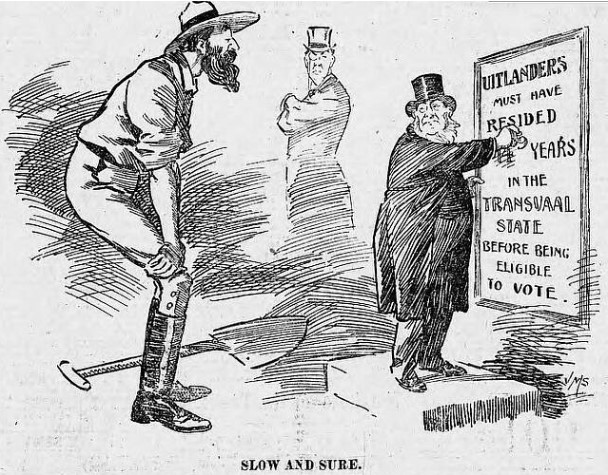
Leaving aside the fact that Pitzer has the literacy level of an 8-year-old, it would still be extraordinary to declare that Kruger’s Transvaal – a nation which not only completely denied the vote to blacks, coloureds, and Indians, but which also blatantly discriminated against Jews, Catholics, and English-speakers[2] – was ‘morally light years ahed [sic]’.
Perhaps Pitzer approves of the fact that the Transvaal Boers still practiced slavery, under the guise of the ‘Apprentice’ system?[3] Or perhaps he was referring to the fact that Kruger and his corrupt claque had started the Boer War by invading their neighbours, and burning and looting the towns and villages they took? [4] Or maybe this surreal claim of ‘moral supremacy’ was based on their flagrant and repeated abuse of the white flag?[5] I guess we shall never know – but it is remarkable that Pitzer publicly lauds a regime which was, by any standards, even more repellent than the later Apartheid government.
But don’t take my word for it. Writing in 1900, this is how the Hollander, Thomas C. Hutten, described Pitzer’s heroes: ‘…to say that the social tendencies of Boerdom are 100 years behind the march of progress would be an insult to the culture of the 18th century. Their votaries are relics of the dogma-crazed Middle Ages, uncompromising disciples of the bigots who exiled Hugo Grotius and blighted the career of the patriot Barneveldt, of the obscurantists whose opposition to every national reform forced Holland from her proud position in the forefront of cosmopolitan enterprise.’[6]
Hutten continued with a scathing assessment of Kruger’s crack-pot and thick-headed followers:
‘They would, perhaps, have done better to settle nearer to the centre of the continent, at the sources of the Congo, or in the Mountains of the Moon. A colony of mental mummies might hold its own in a region of absolute darkness, but could not hope to prosper beside communities basking in the sunlight of civilization… the Transvaal ‘Republic’ is administered in the interests of a conservative clique of about three dozen families. ‘He heaps up pensions and preferments on his relatives in a way that would put Tammany Hall to shame,’ writes Mr T. A. McKenzie in his recently published pamphlet on President Kruger.’[7]
George Bernard Shaw — another man who can hardly be considered a jingo — found himself in a similar position, writing:
‘During the war a curious thing happened in Norway. There, as in Germany, everyone took it for granted that the right side was the anti-English side. Suddenly Ibsen asked in his grim manner, ‘Are we really on the side of Kruger and his Old Testament?’… I saw that Kruger meant the 17th century and the Scottish 17th century at that; and so to my great embarrassment I found myself on the side of the mob.’[8]
An Austrian visitor to the Transvaal described the way the ‘morally superior’ Boers treated the Uitlanders:
‘[Despite] owning property, paying taxes etc., [they] are barred from the right of voting, and enjoy no more political rights than the K****r … that radical reform was absolutely needed in the Transvaal, everyone who has been there will admit.’[9]
But let’s give eminent historian, Andrew Roberts, Baron Roberts of Belgravia, the final word on just how wonderfully ‘moral’ Kruger’s tin-pot republic was:
‘The Transvaal was in no way a democracy. No Catholic or Jew was allowed to vote or hold office. Every Boer was compelled to own a rifle; no non-Boer was allowed to. Johannesburg, with 50,000 mainly uitlander inhabitants, was not even allowed an unelected municipal council. English was banned in all official proceedings. Judges were appointed by Kruger, who controlled all the Government monopolies from jam to dynamite. By far the largest proportion of the tax burden was carried by the uitlanders, yet no open-air public meetings were permitted. Newspapers could be closed down arbitrarily without any reason given. Above all, full citizenship was almost impossible to gain for non-Boers. Pretoria ran a tight, tough, quasi-police state.’[10]

And in terms of the Boers being ‘intellectually light years ahed [sic]’, this self-serving fantasy rather overlooks the fact that – for all this supposed intellectual horse-power – they had elected as President a man so inter-galactically ignorant that he genuinely believed the Earth to be flat.[11] A man so impossibly stupid that he started a war against the Greatest of the Great Powers, thanks to a quasi-lunatic belief that the Almighty (of the Old Testament) would assist his invasion forces.[12]
And while he was especially deranged and ignorant, Kruger was not the only example of this (ahem) ‘intellectual supremacy’. Indeed, the Transvaal Volksraad was a crucible for small-minded, ignorant nonsense: Kruger himself led a (successful) opposition to the introduction of pillar-boxes on the grounds that they were ‘extravagant and effeminate’,[13] while a proposal to formalize a register for births, deaths, and marriages was comprehensively rejected for being ‘an attack on religious principles’. Other Luddite Volksraad members similarly spoke out against the introduction of railways and trams.[14] There were undoubtedly others with keener intellects, but over the years, slack-jawed Volksraad zealots earnestly deliberated over such things as whether or not certain words were real if they could not be found in the Bible, the importance of defining the shape and size of neckties, establishing a monopoly to supply jam, and outlawing barmaids.[15]
The Volksraad’s reaction to a plague of locusts that caused devastation in the Transvaal is instructive. The members generally agreed that it was the work of God and several declared it a sin to try and combat it. One donkey-walloping country-bumpkin even announced that rinderpest and locusts were God’s way of punishing the decadence of the growing English-speaking community in Johannesburg: ‘in former years, before these people and the goldfields were known, there were no plagues.’[16] As the debate raged on, another buffoon sagely advised that the only way to end the plague was to repent one’s sins, while yet another announced:
‘Everybody knew that locusts were a punishment from the hand of God. They had been away from our country for a long time, and there were reasons for their return. If members read their Bibles, they would know this.’[17]
Another village idiot told a fanciful tale about a man whose farm had been spared until the day he had killed a locust. Immediately thereafter, his farm was devastated by the plague.[18] One of the more enlightened Afrikaans leaders wrote in frustration, that due to this widespread God-fearing ignorance:
‘…it is easier to mislead [a Boer] than to lead him. A man who plays upon his vanity and prejudice against England quickly obtains influence. A loud talker and blusterer gets a better hearing than a quiet reasoner. I ascribe this to want of education and complete isolation on the veldt from generation to generation. The depth of their ignorance will hardly be understood by one who does not know them as well as I do … Unfortunately, the ministers of the Dutch Reformed Church, greedy for the fat lamb, the fowl, and the purse, foster this ignorance. One parson actually had the audacity, during the war, to tell his congregation that God must help His chosen people, otherwise He would lose His influence.’[19]
Hutten agreed, describing how dreadful life was for the more open-minded burghers who lived under this Bible-bashing tyranny:
‘A Junta, more narrow-minded, more intolerant, more obstinate than the State Council of medieval Venice, restrains their progressive tendencies, and reduces their suffrage to the formality of ratifying a prearranged programme. Parish bigots complete that system of feudalism. Rationalists exist, but a liquor dealer advertising his stimulants on the temple walls of Mecca would not provoke more immediate ruin than a philosopher expounding the principles of liberalism in a Transvaal country town. An aggressive boycott would be organized in less than 48 hours. The dissenter’s neighbours would be warned to cut his acquaintance. Gangs of superstition-crazed Yahoos would howl under his windows after dark. Good wives, at his approach, would snatch up their youngsters and slam the door in his face. A ceaseless cackle of vituperation and slander would dodge his steps from house to house, from camp to camp.’[20]
With the nonchalant racism of the time, another visitor to South Africa ignored the overwhelming non-white population of the Transvaal but still made a valid point: ‘A country must after all take its character from the large majority of its inhabitants, especially when those who form that majority are the wealthiest, most educated, and most enterprising part of the population’,[21] instead, ‘Mr Kruger has aimed at realizing this paradox: the oppression and plunder of the most enterprising, most educated, the richest and most numerous portion of the [white] population by the poorest, most ignorant, most indolent of minorities’.[22]
And in terms of being ‘light years ahed [sic] physically’, it seems to have escaped Pitzer’s notice that – despite their significant advantage in numbers, mobility, preparedness and alleged physical prowess, the invading Boers proved completely incapable of taking Ladysmith, Mafeking or Kimberley – let alone Durban, Port Elizabeth and Cape Town. Hell, it even took this race of supposed Titans six weeks to take tiny Kuruman – despite outnumbering the scratch garrison of Cape Police and volunteers[23] by 10:1.
None of this should, perhaps, be in any way surprising: soldiers of the British army were picked, well-trained, professionals who had volunteered to serve Queen and Country – and had met fairly rigorous entry requirements and passed the requisite medical tests. In contrast, the invading Boer forces were made-up of commandos which – despite the latter day myths – were simply untrained militia units, in which all burghers of a given district were obliged to serve. As General Ben Viljoen recalled,
‘…immediately martial law is promulgated the entire Boer adult male population is amenable for military service. In the ranks of a commando one finds men of every profession, from the advocate and doctor to the blacksmith and plumber.’[24]
Young Deneys Reitz agreed, describing his comrades in the Pretoria Commando as, ‘mostly young fellows from the civil service and the legal offices and shops in the town. Few of them had ever seen war, or undergone military training’.[25]
So unless one is stupid or blinkered enough to believe that, simply by living in the republics, men were somehow transformed into a physically impressive master race of Supermen, one has to accept that, in reality, plenty of these pressed burghers were cowardly, reluctant, short-sighted, asthmatic, flat-footed, and generally unsuited to military life—as would be the case with any other nation.
And this is not just idle speculation; Ben Viljoen was tasked with raising the Johannesburg Commando in September 1899, but quickly found that these ‘superhuman’ burghers dreamed up all manner of excuses to avoid commando service. Despite the manufactured shrieks and falsehoods of the British ‘massing on the border’, in reality, the Johannesburg Commando moved to the front on 29 September (ie. almost two weeks before the Boers invaded) – but Viljoen only had 400 men instead of the 750 he had counted on.[26] Similar reports came from other towns in both republics, and the Transvaal Government went as far as to set up a special commandeer commission to ‘root out the burghers who were in hiding’.[27] Before long, there were cases of Boers at the front trying to get medical certificates issued to get away on home leave — a practice referred to by their more stout-hearted comrades as ‘bangsiekte’ (fear-sickness). Others took the more rather more drastic route of self-inflicted wounds.[28]

Churchill, standing alone on right, after his capture
With Pitzer’s self-serving – and rather unpleasant – fantasies about racial supremacy thoroughly skewered, let’s turn our attention to his next lie; there is, quite simply, no such thing as ‘the Churchill “Better Men” essay’. What there is, however, is a small section in Churchill’s ‘London to Ladysmith via Pretoria’, where Young Winston records how despondent he had (very briefly) felt, following his capture at the Armoured Train Incident of 15 November 1899:
‘And then, above the rain storm that beat loudly on the corrugated iron, I heard the sound of a chaunt. The Boers were singing their evening psalm, and the menacing notes—more full of indignant war than love and mercy—struck a chill into my heart, so that I thought after all that the war was unjust, that the Boers were better men than we, that Heaven was against us, that Ladysmith, Mafeking, and Kimberley would fall, that the Estcourt garrison would perish, that foreign Powers would intervene, that we should lose South Africa, and that would be the beginning of the end. So for the time I despaired of the Empire, nor was it till the morning sun—all the brighter after the rain storms, all the warmer after the chills—struck in through the windows that things reassumed their true colours and proportions.’[29]
This would be rather like a young officer of the Red Army in 1941, who – having been captured in the early days of the Nazi invasion of the USSR – felt a moment of despondency upon seeing the seemingly endless lines of Panzers rumbling past, and the countless squadrons of Stukas streaking overhead… before waking the next morning, pulling himself together, and realising that Hitler’s invasion would be thwarted sooner or later.
Of course, not only did Pitzer – in his desperation to keep the Apartheid-myths alive – completely ignore that Churchill quickly shook himself out of his momentary depression, but he also ignored that the Great Man made some other, rather more telling, comments in the same chapter. After his capture, for example, he fell into conversation with some Boers:
The war, they said, was going well. Of course, it was a great matter to face the power and might of the British Empire, still they were resolved. They would drive the English out of South Africa for ever, [wait? what? so it wasn’t a ‘defensive invasion’!?] or else fight to the last man. I said: ‘You attempt the impossible. Pretoria will be taken by the middle of March.[30] What hope have you of withstanding a hundred thousand soldiers?’
‘If I thought,’ said the younger of the two brothers vehemently, ‘that the Dutchmen would give in because Pretoria was taken, I would smash my rifle on those metals this very moment. We will fight for ever.’ I could only reply: ‘Wait and see how you feel when the tide is running the other way. It does not seem so easy to die when death is near.’[31]
And, in a previous chapter, following the crushing British victory at Elandslaagte, Churchill’s comments about the Uitlanders of the ILH also don’t in anyway align with Pitzer’s lunatics rantings of Boer racial supremacy:
I talked with a wounded Gordon Highlander—one of those who dashed across the famous causeway of Dargai and breasted the still more glorious slope of Elandslaagte. ‘We had the Imperial Horse with us,’ he said. ‘They’re the best I’ve ever seen.’
The casualty lists tell the same tale. To storm the hill the regiment dismounted less than two hundred men. They reached the top unchecked, their Colonel, their Adjutant, Lieutenant Barnes, seven other officers, and upwards of sixty men killed or wounded—nearly 30 per cent. Many of this corps came from Johannesburg. After this who will dare call Outlanders cowards?[32]
And, at the risk of pricking the bubble of fantasies about the road to war that people like Pitzer indulge in, Churchill also had something to say on the complete lack of preparedness on the side of the British, despite all the evidence that Kruger was planning his invasion:
The attempts to satisfy the conscientious public by giving the republics every possible opportunity to accept our terms and the delays in the despatch of troops which were an expensive tribute to the argument ‘Do not seek peace with a sword,’ have been misinterpreted in South Africa.[33]
and:
A democratic Government cannot go to war unless the country is behind it, and until it has general support must not place itself in a position whence, without fighting, there is no retreat. The difficulty of rallying public opinion in the face of the efforts of Mr. Morley, Mr. Courtney, Sir William Harcourt, and others have caused a most dangerous delay in the despatch of reinforcements. War has been aggravated by the Peace Party; and thus these humanitarian gentlemen are personally—for they occupy no official position—responsible for the great loss of life. They will find their several consolations: Mr. Morley will rejoice that he has faithfully pursued Mr. Gladstone’s policy in South Africa; Mr. Courtney that he has been consistent at all costs; Sir William Harcourt that he has hampered the Government. But for those who lose their sons and brothers in a quarrel thus unnecessarily extended, there will only remain vain regrets, and to the eyewitness only a bitter anger.
For the last three months the Imperial Government has been in the unpleasant position of watching its adversaries grow continually stronger without being able to make adequate counter-preparations.[34]

All of which brings us to Pitzer’s final – though most surreally entertaining – lie: that his late brother used his copy of Kruger, Kommandos, and Kak as toilet paper. To be honest, as long as he bought a copy (though we all know he didn’t), I really couldn’t care less what he did with it. Still, I cannot imagine it making a terribly comfortable, pleasant or hygienic alternative to Andrex. That said, we all have our kinks, and each to his own, I guess.
NOTES:
[1] This accusation is especially bizarre, given that I have always said my go-to reference is General Maurice’s official history of the war. In stark contrast, Mr Pitzer’s go-to reference is simply anything he has randomly pulled out of his rectum
[2] Roberts, Salisbury, Victorian Titan, p.717
[3] Welsh, A History of South Africa, p.238
[4] Stott, The Boer invasion of Natal, p.215
[5] Burne, With the Naval Brigade in Natal, p.39
[6] North American Review, Vol.170, Number 520, March 1900, p.328
[7] North American Review, Vol.170, Number 520, March 1900, p.329
[8] Le May, British Supremacy in South Africa, 1899–1902, p.29
[9] Sternberg & Henderson, My experiences of the Boer War, pp.11–12
[10] Roberts, Salisbury, Victorian Titan, p.717
[11] When Joshua Slocum, the first person to sail single-handedly around the world, met Kruger in early 1898, the old troll declared the earth to be flat, as Slocum recalled: ‘The trip to Kimberley, Johannesburg, and Pretoria was a pleasant one. At the last-named place I met Mr. Kruger, the Transvaal president. His Excellency received me cordially enough; but my friend Judge Beyers, the gentleman who presented me, by mentioning that I was on a voyage around the world, unwittingly gave great offense to the venerable statesman, which we both regretted deeply. Mr. Kruger corrected the judge rather sharply, reminding him that the world is flat. “You don’t mean round the world,” said the president; “it is impossible! You mean in the world. Impossible!” he said, “impossible!” and not another word did he utter either to the judge or to me’. See Chapter 18, Sailing Alone Around the World, by Captain Joshua Slocum, 1900
[12] Botha, From Boer to Boer and Englishman, p.27
[13] Fitzpatrick, The Transvaal from Within, p.307
[14] Gordon, The Growth of Boer Opposition to Kruger, p.8
[15] Fitzpatrick, The Transvaal from Within, pp.305–11
[16] Gordon, The Growth of Boer Opposition to Kruger, p.13
[17] Gordon, The Growth of Boer Opposition to Kruger, p.14
[18] Fitzpatrick, The Transvaal from Within, p.308
[19] Botha, From Boer to Boer and Englishman, p.9
[20] North American Review, Vol.170, Number 520, March 1900, p.329
[21] Bryce, Impressions of South Africa, p. 470
[22] Guyot, Boer Politics, p. 62
[23] Kruger, Goodbye Dolly Gray, p.165
[24] Viljoen, My Reminiscences of the Anglo-Boer War, p.275
[25] Reitz, Commando, p.20
[26] Grundlingh, The Dynamics of Treason, p. 20
[27] Grundlingh, The Dynamics of Treason, p. 21
[28] South African Military History Society, Military History Journal, Vo.8, No.6, December 1991
[29] Churchill, London to Ladysmith via Pretoria, pp.108-109
[30] Churchill was guilty of being a little optimistic here: Bloemfontein was taken on 13 March 1900, but Pretoria only fell on 5 June
[31] Churchill, London to Ladysmith via Pretoria, pp.106-107
[32] Churchill, London to Ladysmith via Pretoria, p.46
[33] Churchill, London to Ladysmith via Pretoria, p.21
[34] Churchill, London to Ladysmith via Pretoria, pp.24-25

2 Comments
Pitzer should just Pitz Off the stupid bastard
And what does an arch liar with one massive inferiority awareness as “man” even mean?
These idiots walk amongst us
Christ alone knows what he was jabbering about. But I do hope he pops up to try to defend his lies – I need a laugh.
Add Comment